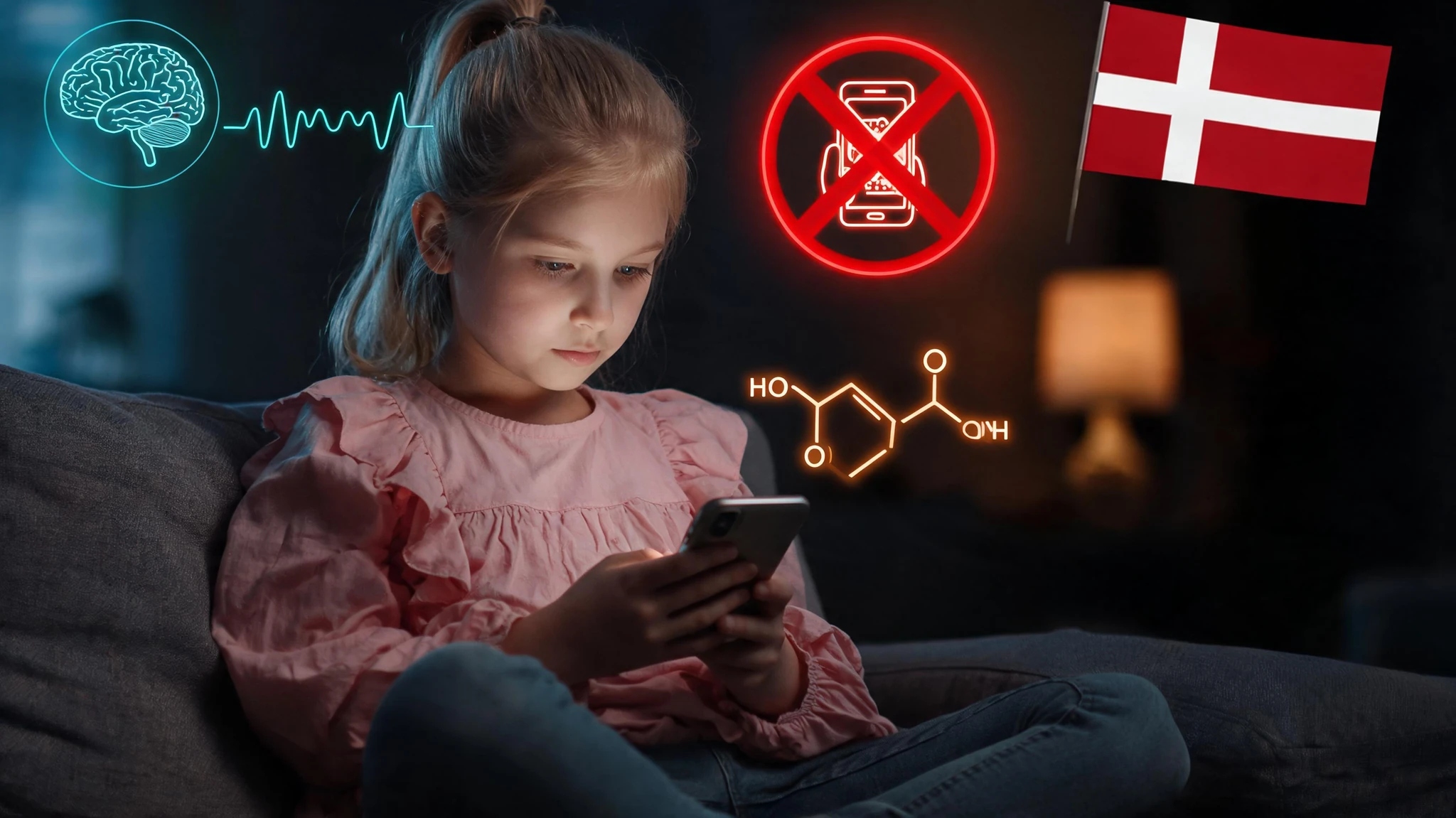
Denmark plans to bar children under 15 from using social media platforms like TikTok, Instagram, Snapchat, and YouTube, with enforcement tied to a national digital identity wallet that goes live in spring 2026. The policy was announced by Prime Minister Mette Frederiksen’s coalition in November 2025 and could take legal effect by the middle of this year, making Denmark the first European country to draw such a hard line at the age of 15.
Parents will keep some room to negotiate. Under the proposed rules, families can grant limited access for 13- and 14-year-olds through a parental consent process, but children below 13 will be off the platforms entirely. The justification, repeated by Danish ministers and echoed in a growing body of peer-reviewed research, is that something about the way social platforms work hits adolescent brains harder than adult ones, and that the timing of that hit matters.1
What exactly does the Danish proposal say?
The headline number is age 15. That is the floor. Children under 13 will not be allowed to hold accounts on the named platforms at all, which already mirrors the platforms’ own published terms but has so far been impossible to enforce. Children aged 13 and 14 will be allowed limited access only with documented parental consent, processed through Denmark’s MitID system, the country’s national digital identity infrastructure used today for everything from banking to tax filings.
The new Digital Identity Wallet, scheduled to launch in spring 2026 alongside the rest of the European Union’s eIDAS 2.0 rollout, is what makes age verification practical for the first time. Instead of asking a child to type a birth year into a sign-up form, platforms will be required to check a cryptographically signed age token issued by the wallet. The platform never sees the child’s name or full date of birth. It just receives a yes or no answer to the question, “Is this user old enough?”
Penalties live inside the European Union’s Digital Services Act, which already gives regulators the power to fine non-compliant platforms up to 6 percent of global annual turnover. For a company at TikTok’s scale, that is a credible deterrent rather than a parking ticket. The Act also obliges very large online platforms to assess systemic risks to minors, which Denmark argues is exactly what its under-15 rule is meant to address.
Politically, the proposal has unusual breadth. Multiple parties across the governing coalition and the opposition have signaled support, which is rare in a system designed for narrow coalitions. The bill still needs to clear formal parliamentary procedure, but ministers have publicly aimed for the law to take effect by mid-2026.
Why a teenage brain reacts differently
The Danish government did not pull the age 15 threshold out of thin air. It tracks a specific finding from Cambridge psychologists Amy Orben, Andrew Przybylski, and Sarah-Jayne Blakemore, who in 2022 published a study in Nature Communications called “Windows of developmental sensitivity to social media.” Drawing on two large British longitudinal datasets covering more than 84,000 people, the researchers found that the relationship between social media use and life satisfaction was strongest, and most negative, during narrow age windows in early adolescence. For girls, the most sensitive window fell roughly between ages 11 and 13. For boys, it sat slightly later, around 14 to 15.1

What was striking was that the same teenagers, followed up a year later, also showed dips in life satisfaction at age 19, regardless of gender. So the link is not a one-time effect tied to puberty. It seems to flare up at moments when the social brain is rewiring itself most aggressively, both in early adolescence and again as people leave home.
That fits what neuroscientists already know about adolescent brain development. The reward system matures earlier than the prefrontal cortex, which handles impulse control and long-term planning. The mismatch creates a stretch of years when novelty, social comparison, and peer feedback feel unusually intense. A scrolling feed engineered to deliver exactly those signals on demand lands on a brain that is, in a real sense, primed to overreact.
What the wider evidence actually shows
It would be tidy to say research has settled this. It has not. Earlier work by the same Oxford team, looking at 12,000 British adolescents in a 2019 paper in PNAS, found that social media’s effect on life satisfaction was, in absolute terms, small. The link was real but modest, and ran in both directions: lower life satisfaction predicted more social media use, just as more use predicted slightly lower satisfaction.2 A teenager who scrolled an extra hour a day was not destined to be unwell.
San Diego State University psychologist Jean Twenge has been pushing harder. In a 2018 analysis of more than 40,000 American children and teens published in Preventive Medicine Reports, Twenge and W. Keith Campbell reported that high screen-media users showed lower curiosity, lower self-control, more difficulty making friends, and higher rates of anxiety or depression diagnoses. Among 14- to 17-year-olds, those who used screens more than seven hours a day were more than twice as likely to have been diagnosed with depression or anxiety as light users.3
A second Twenge paper, published in Sleep Medicine in 2019, narrowed the focus to sleep, the variable most directly affected by what a child does with the last hour before bed. In a population-based sample of U.S. children aged 0 to 17, more screen time was associated with shorter sleep, and the effect was driven almost entirely by portable electronic devices rather than televisions.4 A phone in the bedroom is not the same kind of object as a television in the living room, and the data behave that way.

Where the picture gets more interesting is when researchers stop treating “screen time” as a single quantity. In a 2021 paper in Social Psychiatry and Psychiatric Epidemiology, Twenge and Eric Farley reported that not all screen time was created equal. Social media and electronic gaming were more strongly tied to lower well-being than other digital activities, and the associations were larger for girls than for boys, especially for social media.5 That is one of the reasons Denmark’s policy targets specific platforms rather than total screen hours.
So is the link real, or has it been overstated?
Both, depending on which question you ask. The average effect of social media on the average teenager is small. The average effect on a girl in early adolescence with a phone in her bedroom and a feed full of curated bodies appears to be larger. Public health policy is rarely written for averages. It tends to be written for the tail of the distribution, where the worst outcomes cluster, and that tail is part of what Danish ministers have pointed at when defending the bill.
The honest reading of the literature is that social media is a risk factor that interacts with other risk factors. A child who already has poor sleep, social anxiety, a thin in-person friend group, or a tendency to compare themselves harshly is more likely to be hurt by heavy social media use than a child without those conditions. The platforms did not invent any of those conditions, but they can amplify them, and they can do so during the exact window when the adolescent brain is most plastic.1
Will the ban actually work?
Enforcement is the live question. South Korea, Australia, and France have all experimented with versions of an age-based digital curfew or ban, and the practical record is mixed. Tech-savvy children route around blunt restrictions almost immediately. What is different about the Danish design is that the ban does not depend on the platform’s good faith. It depends on the digital identity wallet, which a child cannot fake without committing identity fraud against the Danish state, a much larger barrier than lying about a birthday on a sign-up form.
Even so, expect leakage. VPNs, shared family accounts, and accounts created by older siblings are obvious workarounds. Critics also worry about the privacy tradeoff. Building the infrastructure for hard age verification creates a central system that, if breached or repurposed, could be used for far more than keeping 12-year-olds off TikTok. Danish privacy regulators will have to keep close watch on how the wallet’s age tokens are issued, logged, and audited.
There is also a quiet concern that a hard ban displaces use rather than ending it. A 14-year-old cut off from Instagram and Snapchat may simply spend that time on group chats, anonymous forums, or platforms not yet on the regulator’s list, some of which carry their own risks. Banning the named platforms is the easy part. Building the broader habits around childhood is harder.

What it means for families outside Denmark
Most readers will not be Danish. The policy still matters because regulators in Norway, the United Kingdom, France, and several Australian states are actively watching. If the Danish wallet-based system holds up technically and politically through 2026, expect copies. Britain’s Online Safety Act and Australia’s recently passed under-16 social media rules already point in the same direction.
Inside the home, the lever a parent has is smaller than a national law but, in some ways, more useful. The research suggests a few practical priorities that do not depend on legislation. Keep phones out of the bedroom overnight, since the sleep effect is one of the cleanest signals in the data.4 Delay private accounts on image-heavy platforms in early adolescence, especially for girls between roughly 11 and 13, the window where the well-being curve dips most sharply.1 When access does begin, treat it like learning to drive, with practice, conversation, and a slow widening of the speed limit, not a single switch flipped on a birthday.
None of that requires you to demonize a teenager’s phone. It does require accepting that the device in their pocket is a different category of thing than the television in the living room was for previous generations, and that the evidence supporting that distinction has grown stronger, not weaker, over the past five years.3,5
Common questions about the Danish social media ban
When does the Danish under-15 social media ban take effect?
The Danish government has aimed for the law to take effect by mid-2026. The bill still requires formal parliamentary passage, and the technical age-verification layer is tied to the rollout of Denmark’s Digital Identity Wallet in spring 2026.
Which platforms are covered by the proposed ban?
The named platforms are TikTok, Instagram, Snapchat, and YouTube, the services Danish ministers cited as the most heavily used by children. The exact final list will depend on the legislative text and on which services the regulator classifies as social media under the EU Digital Services Act.
Can parents grant access for younger teens?
Yes, partially. The policy lets parents authorize limited access for 13- and 14-year-olds through a documented consent process. Children under 13 are excluded entirely.
Does the research really show social media harms teens?
The evidence supports a small average effect across all teenagers and a larger effect during specific developmental windows, especially early adolescence for girls and around age 19 for both sexes.1 It is a risk factor that interacts with sleep, body image, and existing mental health, not a single switch.
What can a parent outside Denmark do?
Keep phones out of bedrooms overnight, delay image-heavy platforms during early adolescence, and treat the introduction of social media as a gradual learning process. These changes are supported by the same body of research the Danish policy draws on.
The honest bottom line
Denmark is running a real-world experiment that the rest of Europe is going to study closely. The strongest case for the law is not that social media destroys every teenage life it touches, because the data do not say that. The case is that for a subset of young people, during a specific window of brain development, certain platforms appear to make existing problems worse, and that subset is large enough to justify acting at the population level rather than waiting for individual families to figure it out alone.
Whether the ban survives contact with reality, with VPNs, with sibling accounts, and with the next generation of platforms not yet on anyone’s list, will be the more interesting question over the next two years. Until then, the most useful thing a parent can do is read the research with the same care Danish lawmakers say they did, and decide what the right age and the right platforms look like inside their own house.
Sources
- Orben A, Przybylski AK, Blakemore SJ. Windows of developmental sensitivity to social media. Nat Commun. 2022. PubMed: 35347142
- Orben A, Dienlin T, Przybylski AK. Social media’s enduring effect on adolescent life satisfaction. Proc Natl Acad Sci U S A. 2019. PubMed: 31061122
- Twenge JM, Campbell WK. Associations between screen time and lower psychological well-being among children and adolescents: Evidence from a population-based study. Prev Med Rep. 2018. PubMed: 30406005
- Twenge JM, Hisler GC, Krizan Z. Associations between screen time and sleep duration are primarily driven by portable electronic devices: evidence from a population-based study of U.S. children ages 0–17. Sleep Med. 2019. PubMed: 30639033
- Twenge JM, Farley E. Not all screen time is created equal: associations with mental health vary by activity and gender. Soc Psychiatry Psychiatr Epidemiol. 2021. PubMed: 32743778