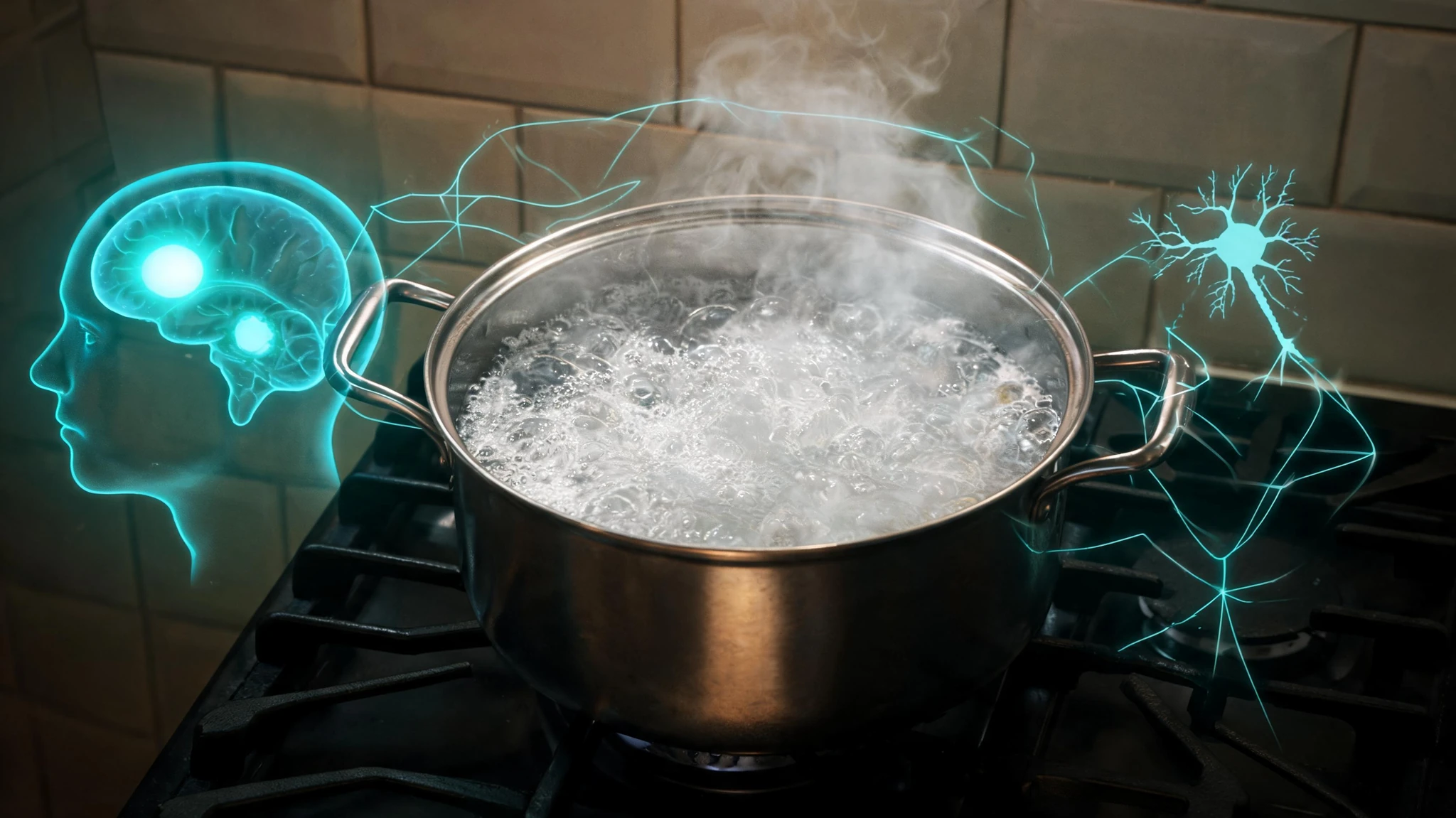
Big decisions made while angry tend to look worse the next morning, and there is a simple reason for that. When the brain registers a threat or an injustice, the amygdala fires hard and the prefrontal cortex, the part that does careful thinking, gets less of the resources it needs to do its job3,4. People in that state estimate risk more optimistically, blame other people more readily, and underweight information that contradicts whatever feels true at the moment1,2.
That is not a moral failing. It is a predictable shift in how the brain weights inputs. The takeaway is mundane and useful. If a decision can wait an hour, let it wait. The same brain that wrote the angry email at 9 p.m. will read it differently at 7 a.m., and that difference is mostly biology, not character.
What actually happens in the brain when you get angry
The amygdala is a small, almond-shaped cluster sitting deep in each temporal lobe. It is one of the brain’s first responders for anything that might matter to survival, including insults, surprises, and threats to status. When it fires, it kicks off a cascade: heart rate up, breathing faster, cortisol and adrenaline released, blood routed toward muscles. People have called this the fight-or-flight response since the 1920s, and the basic outline still holds.
The trouble is what happens upstream of all that, in the prefrontal cortex. The PFC is the region behind your forehead that compares options, weighs long-term consequences, holds your impulses in check, and remembers the goals you set last Tuesday. Stress hormones tilt the brain’s balance away from the PFC and toward older, faster systems3. Lupien and colleagues, in a 2009 review in Nature Reviews Neuroscience, summarized decades of work showing that acute and chronic stress reshape activity in exactly the regions you depend on for careful judgment3.
So when people say their “thinking brain went offline” in a fight, they are describing something real. It does not literally switch off. It loses bandwidth. The reactive, pattern-matching parts of the brain take a bigger share of the steering wheel, and decisions get faster, blunter, and more confident than the evidence warrants.

Why anger specifically pushes you toward bad bets
Not every strong emotion bends decisions in the same direction. This is one of the more useful findings of the last twenty-five years of decision research. In a 2001 paper titled “Fear, anger, and risk,” Jennifer Lerner and Dacher Keltner showed that fearful people make pessimistic risk estimates and act cautiously, while angry people make optimistic risk estimates and act boldly1. Same situation, opposite reads.
That asymmetry matters. Anger is the emotion most likely to convince you that you have a clear view of a complicated situation, that the other side is acting in bad faith, and that you can handle whatever comes next. None of that is necessarily true. It just feels true because anger comes packaged with a sense of certainty and control. Lerner and her colleagues later expanded the framework into a broader model of how specific emotions shape judgment in their 2015 review in the Annual Review of Psychology, which is still one of the cleanest summaries of the field2.
The practical version: when you feel certain and a little reckless at the same time, that is a signal worth listening to. Not because the feeling is wrong, but because it is famously bad at calibration.
The boiling water metaphor, and why it actually works
There is an old line about boiling water that gets passed around online: “You cannot see your reflection in boiling water. Similarly, you cannot see the truth in a state of anger. When the water calms, clarity comes.” It is folk psychology, and it happens to be a decent map of what neuroscience finds.
When the brain is hot, it does what hot brains do. It picks up on threats faster, generates blame faster, and discounts ambiguous evidence faster. Once the body’s stress response settles, usually within twenty to ninety minutes if nothing keeps poking at it, the prefrontal cortex regains room to do its slower work. That is when nuance shows up. That is when “I am being disrespected” can sit alongside “they had a hard week,” and you can choose how to weight each one.
This is not about denying anger. Anger is information. It tells you that something feels off, that a boundary may have been crossed, that something matters to you. The mistake is treating that information as if it were a finished analysis. It is not. It is a first draft written in a hurry.

What the research says about regulating it in the moment
If you cannot avoid the moment, you can shape what your brain does with it. Kevin Ochsner and James Gross, in a widely cited 2005 paper in Trends in Cognitive Sciences, mapped out the main strategies people use to regulate emotion and which ones tend to work4. Reappraisal, meaning a deliberate effort to reframe what an event means, generally outperforms suppression, which is just clamping down on the outward signs while the storm continues underneath.
In plain terms, suppressing the angry face but not the angry thinking does not protect your decision quality. Reframing the situation does. “Maybe my partner is short with me because their meeting went badly, not because they think I am a fool” is the kind of sentence that, when you actually believe it, takes some heat out of the system and gives the prefrontal cortex room to operate.
A few things tend to help in the first ten minutes:
- Slowing the breath out so that exhales are longer than inhales for a couple of minutes. This nudges the parasympathetic nervous system into action.
- Moving the body. A short walk, even just down a hallway, breaks the loop more efficiently than sitting still and trying to think your way out.
- Naming the feeling out loud or in writing. “I am angry about the email about the budget” is more useful than “everything is unfair right now,” because it gives the prefrontal cortex something specific to chew on.
None of these are magic. They give the slower system a chance to catch up.
When anger gets stuck on, the costs add up
Some people live with anger that is harder to settle. A 2019 study by Bertsch and colleagues, looking at men with borderline personality disorder, found that acting out anger was associated with weaker prefrontal control over angry impulses on a behavioral task5. The pattern is suggestive rather than conclusive, and the sample is specific, but it lines up with the broader picture: when the prefrontal brake is weaker, the angry response wins more often, and the decisions that follow are more impulsive.
You do not need a clinical diagnosis to recognize the dynamic. Sleep loss, chronic stress, alcohol, and certain medications all weaken the same prefrontal circuits that hold anger in check. That is part of why an argument that would have been a footnote on a Saturday turns into a fight on a Tuesday after a bad week. The brain is not the same brain.

The simple rule: build a delay into anything that matters
The most reliable protection against anger-driven decisions is also the least glamorous. Build a delay. Whatever the decision is, if you can afford to wait, wait. An hour for small things, a night for medium things, several days for the big ones. This is the practical translation of decades of research on how stress hormones move through the body and how slowly the prefrontal cortex regains its full footing3.
A few specific delays that pay for themselves:
- Drafting the angry message and saving it as a draft. If it still reads right in the morning, send it. Most do not.
- Setting a personal rule that big purchases over a certain amount cannot happen the same day as a fight, a layoff, or a funeral.
- Telling people close to you, in advance, that you do not negotiate important things during a flare-up. This is easier to enforce when other people know the rule.
None of this denies the legitimacy of the original feeling. Sometimes the email did deserve a sharp reply. Sometimes the relationship really is not working. The delay is not about talking yourself out of what you know. It is about giving the slower, more careful part of you a chance to weigh in before the faster, louder part has already burned the bridge.
What this does not mean
It would be a misread to take any of this as “do not feel angry.” Anger has a function. It marks where boundaries are. It motivates action when something needs to change. People who never feel angry are not enlightened; they are usually disconnected from something they care about. The point is not to extinguish the signal. The point is to stop letting the signal write the contract.
It would also be a misread to think every angry decision is a bad one. Sometimes the heat is exactly what was needed to finally push a decision over the edge. Plenty of people quit toxic jobs in a hot moment and never regret it. Plenty of relationships end in a single conversation that should have happened years earlier. The research on emotion and decision making does not say that angry decisions are always wrong2. It says they are systematically biased in particular directions, and being aware of that bias is most of the protection.
Common questions about anger and decision making
How long does it take for anger to clear physically?
For most healthy adults, the acute hormonal response begins to settle within twenty to ninety minutes once the trigger is gone. If you keep replaying the trigger in your head, the response keeps refreshing, which is part of why distraction works better than rehearsing the argument.
Is counting to ten actually useful, or is it folk advice?
It is folk advice that happens to nudge a real mechanism. The brief pause gives the prefrontal cortex a moment to engage before the impulsive response fires. It is not a complete solution, but as a one-second buffer it works better than nothing.
Are some people just wired to make worse decisions when angry?
There is meaningful variation in how strongly the prefrontal cortex regulates anger across individuals, and clinical studies suggest weaker regulation is associated with more impulsive anger expression5. Most of that variation responds to practice, sleep, and not being chronically depleted.
Does suppressing the angry expression help?
Suppressing the outward expression while still ruminating internally tends not to improve decision quality and can have its own costs over time4. Reframing the situation, rather than just hiding the face, is the more reliable move.
When should I worry about my anger?
If anger is regularly destroying relationships, work, or sleep, that is worth talking to a clinician about. The same is true if calming techniques that used to work no longer do. There is no virtue in toughing it out alone when the same patterns keep producing the same wreckage.

Sitting with the harder version
None of this makes the moment easier. When something genuinely unfair has happened and the body is humming with cortisol, the advice to wait can feel insulting. The waiting does not have to be calm. It just has to be a wait. You can pace, you can vent to a friend, you can write the unsent letter. The point is only that the consequential action, the email that goes out, the words that get spoken, the contract that gets signed, lands on the desk of the slower brain, not the faster one.
If the boiling water metaphor lands, it is because most people have lived the small version of it. The water calms. The reflection comes back. What you saw at full boil was not nothing, but it was not the whole picture either. The version of you that shows up an hour later is not weaker. That version has more of the brain online, and that is usually the version you want signing your name.
Sources
- Lerner JS, Keltner D. Fear, anger, and risk. Journal of Personality and Social Psychology. 2001. PubMed: 11474720
- Lerner JS, Li Y, Valdesolo P, Kassam KS. Emotion and decision making. Annual Review of Psychology. 2015. PubMed: 25251484
- Lupien SJ, McEwen BS, Gunnar MR, Heim C. Effects of stress throughout the lifespan on the brain, behaviour and cognition. Nature Reviews Neuroscience. 2009. PubMed: 19401723
- Ochsner KN, Gross JJ. The cognitive control of emotion. Trends in Cognitive Sciences. 2005. PubMed: 15866151
- Bertsch K, Krauch M, Roelofs K, Cackowski S, Herpertz SC, Volman I. Out of control? Acting out anger is associated with deficient prefrontal emotional action control in male patients with borderline personality disorder. Neuropharmacology. 2019. PubMed: 30553826