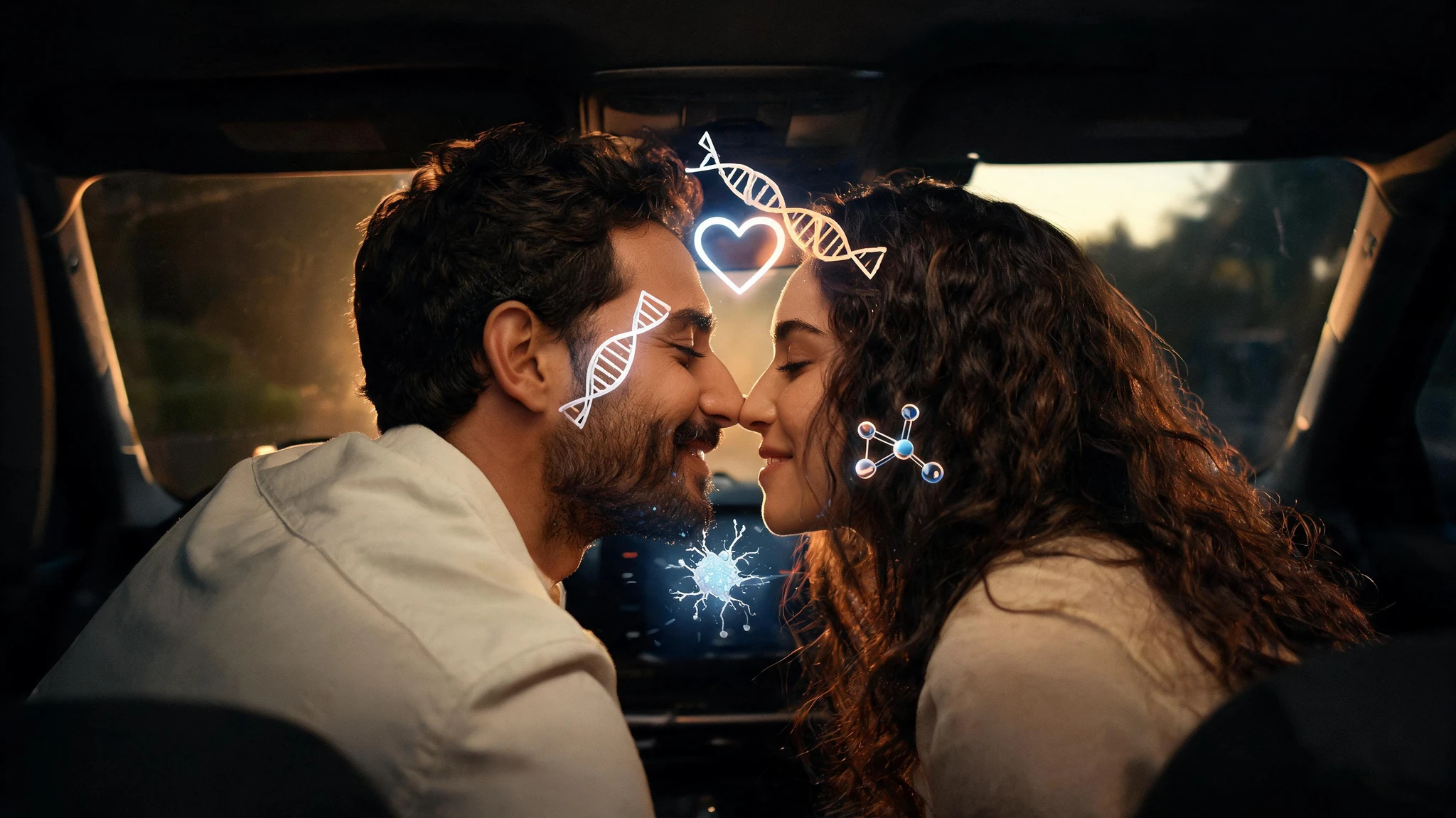
A ten-second kiss transfers around 80 million bacteria between two mouths, and in 2014 a Dutch team led by Remco Kort actually counted them, swabbing 21 couples before and after a kiss and tracking the shift in their oral microbiomes in Microbiome.1 That single, slightly absurd finding is the part of the science that gets quoted everywhere. The fuller picture is more interesting, and quieter. Researchers in evolutionary psychology, communication studies, and immunology have spent the last two decades poking at what a daily kiss does to a human body, and a few effects keep showing up in the data.
This is not a magic-bullet article. The benefits are real, modestly sized, and measurable in a lab. None of them replace sleep, a vegetable, or therapy. But if you have been kissing the same person every morning for a decade and wondering whether it counts as health behaviour, the honest answer is: a little, in six fairly specific ways.
What actually happens to your mouth?
Start with the microbiome, because that is where the cleanest data lives. Kort’s team in Amsterdam recruited couples at a zoo, swabbed their tongues and saliva, asked one partner to drink a probiotic yoghurt, then asked them to kiss intimately for ten seconds, then swabbed again.1 They could detect the marker bacteria in the receiving partner straight after the kiss. Couples who reported kissing nine or more times a day had more similar oral microbiomes than couples who kissed less often, even after controlling for the fact that they shared a household and a diet.
What that means in plain terms: long-term partners drift toward sharing a community of bacteria in their mouths. Some of those bacteria are protective. Streptococcus salivarius, for example, is a well-known commensal that crowds out more aggressive strains. The body’s mouth ecosystem is not sterile and is not supposed to be. A regularly kissed mouth tends to look, microbially, like a stable shared garden rather than a monoculture.
Behavioural anthropologist Helen Fisher has popularised the idea that this microbial exchange amounts to a gentle training session for the immune system. The framing is hers, not a conclusion from a controlled trial. The conservative read is that you are exposing your immune system to a small, familiar set of antigens on a regular basis, which is biologically not nothing, but also not a substitute for a flu shot.
One detail from the Kort paper is worth lingering on. The researchers found that women perceived their partners as more similar in oral microbiota than the actual sequencing data showed. People assume their kissing partner’s mouth is closer to their own than it really is. The microbes converge, but slowly, and never completely. Kissing nudges, it does not merge.

Does kissing actually lower stress?
Yes, and the cleanest demonstration of that comes from a 2023 study by Kory Floyd and colleagues in Health Communication, drawing on a national probability sample of US adults.4 Floyd’s team had been studying affectionate communication and lipid profiles for years. The 2023 paper specifically modelled kissing frequency, perceived stress, and blood lipid markers, and found that the link between more frequent kissing and healthier lipid profiles was statistically mediated by stress. People who kissed their partner more often reported lower stress, and lower stress tracked with friendlier cholesterol numbers.
That is a careful sentence, and it should be. The study is correlational. Nobody assigned half the country to kiss more and then waited for their LDL to drop. What it does say is that, within a representative US sample, the kiss-stress-lipid pathway holds up under statistical scrutiny, which is a higher bar than a magazine claim that kissing is heart-healthy.
The mechanism is plausible. Affectionate physical contact reliably lowers cortisol and raises oxytocin in lab settings, and chronic cortisol elevation is one of the routes by which stress nudges metabolic markers in the wrong direction. A short kiss is a small dose of that calming signal, repeated daily.
Why does the right person’s kiss feel different?
Robin Dunbar’s group at Oxford spent several years asking that question, and Rafael Wlodarski and Dunbar’s 2013 paper in Archives of Sexual Behavior is the go-to source.2 They surveyed more than 900 adults about how they used kissing in short-term and long-term relationships, and tested three hypotheses: that kissing helps assess a partner, that it helps maintain a bond, and that it raises arousal. The strongest support showed up for the assessment and bond-maintenance functions. People in long-term relationships rated kissing’s importance as more closely tied to relationship satisfaction than people in short-term flings did.
A companion 2013 paper in Human Nature looked at how women’s attitudes toward kissing shifted across the menstrual cycle.3 Wlodarski and Dunbar found that the importance women placed on kissing at the start of a relationship was higher in fertile-window phases of the cycle, especially when judging short-term partners. The translation is unromantic but useful: your sense of whether a kiss is good or off is not arbitrary. It is doing real assessment work, and that work is sensitive to hormonal context.

Is the post-kiss glow real?
The popular claim, repeated in every listicle, is that kissing increases blood flow to the face, which stimulates collagen and elastin production, which keeps skin firm. That is one of those statements where each clause is partially defensible and the chain as a whole is shakier than it sounds.
Increased blood flow to the face during arousal? Yes, easily measurable. Mechanical stretching and contracting of facial muscles during a passionate kiss? Also yes, the orbicularis oris and surrounding muscles do work. The leap to durable collagen synthesis is where the evidence thins. Skin fibroblasts respond to mechanical loading, but the loads delivered by a kiss are small, and no controlled study has shown that kiss frequency predicts measurable changes in skin elasticity over months.
A more honest version is this: kissing produces the same kind of transient flush you get from light exercise or a hot shower, and chronic, low-grade increases in facial circulation are good for skin, but anyone selling kissing as a wrinkle treatment is selling you the romantic version of a brisk walk. Take the glow as a real, short-term thing, and let dermatologists keep their day jobs.
How many calories, really?
The widely circulated number is 5 to 26 calories per minute for passionate kissing. The lower end is roughly defensible. The upper end almost certainly is not. Resting metabolic rate for a 70-kilogram adult sits around 1 calorie per minute, and even moderate exercise rarely pushes adults past 8 to 10 calories per minute outside structured sport. Twenty-six calories a minute is sprinting territory, and a kiss is not a sprint.
The same caveat applies to the often-quoted figure that a passionate kiss activates 23 to 34 facial muscles and up to 112 postural muscles. Those numbers come from popular sources rather than a peer-reviewed muscle-EMG study. They are probably in the right ballpark for the facial muscles, since smiling alone recruits more than a dozen, and probably overstated for the postural count, which would imply that nearly every muscle from the neck down lights up. Treat both numbers as folklore-with-a-grain-of-truth, not as biology.

Can a kiss really calm an allergy?
This is the strangest finding in the literature, and it comes from Hajime Kimata, a Japanese clinical immunologist who ran a series of small but ingeniously designed experiments in the early 2000s. In a 2003 paper in Physiology & Behavior, Kimata measured allergic skin wheal responses in patients with mild allergic rhinitis or atopic eczema, before and after a 30-minute session of kissing their partner with music playing.5 The skin wheal response to allergens dropped, and so did plasma levels of certain neurotrophins involved in allergic inflammation.
The samples were small, the design was unusual, and a single research group’s findings always need replication. But the direction of the effect is consistent with what we know about how parasympathetic activation, oxytocin, and a calmer autonomic state dial down acute allergic reactions. If a long kiss can move the needle on a histamine-driven skin wheal in 30 minutes, it is at least suggestive that the broader category of warm physical affection is tugging on the same biology.
None of this means a kiss replaces an antihistamine. It does mean that the autonomic and immune systems are talking to each other constantly, and that what feels like a soft moment can register as a measurable physiological event. Kimata published several papers in this vein, and the broader pattern across them is that being affectionately attended to, even briefly, dampens the kinds of inflammatory readouts that allergists actually measure in clinic.
Six effects, honestly summarised
Pulled together, the science says a regular kiss between long-term partners does roughly six things, in descending order of how confident the evidence is. It shifts your oral microbiome toward your partner’s, in a way that is detectable within minutes.1 It plays a real role in long-term partner assessment and bond maintenance, on a par with other forms of affectionate touch.2,3 It correlates, through a stress pathway, with healthier blood lipid profiles in large samples.4 It produces transient increases in facial blood flow, modest in magnitude. It very likely lowers cortisol and raises oxytocin briefly, in line with other affectionate-touch research. And, in at least one researcher’s careful experiments, it dampens acute allergic skin reactions.5
That is a more sober list than the listicle version, and a longer one than the dismissive version. Both extremes get this wrong. The benefits are not magical, and they are not zero.

Common questions about kissing and health
How often is “regularly enough” to see any of these effects?
The Kort microbiome study saw the strongest sharing in couples kissing nine or more times a day, but smaller effects appeared at lower frequencies. The Floyd lipid-stress data was sensitive to general kissing frequency, not a specific daily count. A few times a day is plausibly enough to be in the range studied.
Does a quick peck count, or does it have to be a long kiss?
For microbial exchange, longer and more open kisses transfer more bacteria, so a peck does not move the needle much there. For the stress and bond-maintenance effects, the relationship signal probably matters as much as the duration. A meaningful peck in the right moment likely does more than a perfunctory long kiss.
What about kissing when one of you is sick?
This is where the immune-training framing has limits. Sharing microbes is one thing. Sharing a streptococcal infection or a respiratory virus is another. If your partner has an active illness, a temporary pause is sensible, and not particularly romantic, but not particularly tragic either.
Does any of this apply to non-romantic kisses, like with a child or parent?
The microbiome and oxytocin findings probably extend in some form. The lipid and bond-maintenance findings were specifically about romantic partnerships and should not be quietly transferred. Affection between family members has its own literature and its own benefits.
Why this still matters even when the effects are small
Most of what keeps a body well over decades is small, repeated, and easy to dismiss. Sleep is small and repeated. So is brushing your teeth, walking to the corner shop, eating a piece of fruit, sitting next to someone you love. The science of kissing is not going to upend any of that. It quietly joins the list, with reasonable evidence behind it, and it asks nothing of you that you were not already going to do.
If a daily kiss with someone you trust shifts your oral bacteria toward a friendlier mix, briefly drops your cortisol, and signals to your nervous system that you are safe, that is a real, ordinary piece of health behaviour. The research keeps catching up to what the body already knew.
Sources
- Kort R, Caspers M, van de Graaf A, van Egmond W, Keijser B, Roeselers G. Shaping the oral microbiota through intimate kissing. Microbiome. 2014. PubMed: 25408893
- Wlodarski R, Dunbar RI. Examining the possible functions of kissing in romantic relationships. Archives of Sexual Behavior. 2013. PubMed: 24114390
- Wlodarski R, Dunbar RI. Menstrual cycle effects on attitudes toward romantic kissing. Human Nature. 2013. PubMed: 24078298
- Floyd K, et al. Lipidemic Effects of Kissing are Mediated by Stress: Results from a National Probability Sample. Health Communication. 2023. PubMed: 35287520
- Kimata H. Kissing reduces allergic skin wheal responses and plasma neurotrophin levels. Physiology & Behavior. 2003. PubMed: 14637240