Five minutes a day. That is what a 2023 Stanford trial led by Melis Balban and Andrew Huberman gave its participants, and it was enough to move the needle on mood more than the same five minutes of mindfulness meditation.1 The breathing pattern they tested has a slightly odd name, cyclic sighing, and a very simple shape. You inhale through the nose, top up that inhale with a second short sip of air, and then let a long, slow exhale leave through the mouth. Repeat for five minutes. That is the whole practice.
The study, published in Cell Reports Medicine, randomized 114 healthy adults to one of four conditions: cyclic sighing, box breathing, cyclic hyperventilation, or mindfulness meditation. After a month of daily practice, the cyclic sighing group reported the largest improvements in positive affect and the steepest drops in respiratory rate at rest.1 The result is small, the sample is modest, and the authors hedge accordingly. Still, for a free practice that costs nothing and takes less time than brewing coffee, it is hard to ignore.
What is cyclic sighing, exactly?
A cyclic sigh is a deliberate version of something your body already does without asking permission. Roughly every five minutes, in the background of ordinary life, you take a physiological sigh: a normal breath followed by a second, smaller inhale, and then a longer exhale. Sleep researchers logged it decades ago. It happens more often when you are stressed, and it appears to reset the lungs by reinflating alveoli that have collapsed during shallow breathing.
The Stanford team took that involuntary mechanism and turned it into a five-minute drill. Inhale through the nose for about four seconds. At the top of the breath, sip in a second small inhale. Then exhale slowly through the mouth, drawing the exhale out for roughly twice as long as the combined inhale. There is no counting app required. The instruction “make the exhale longer than the inhale” is enough to hit the target.
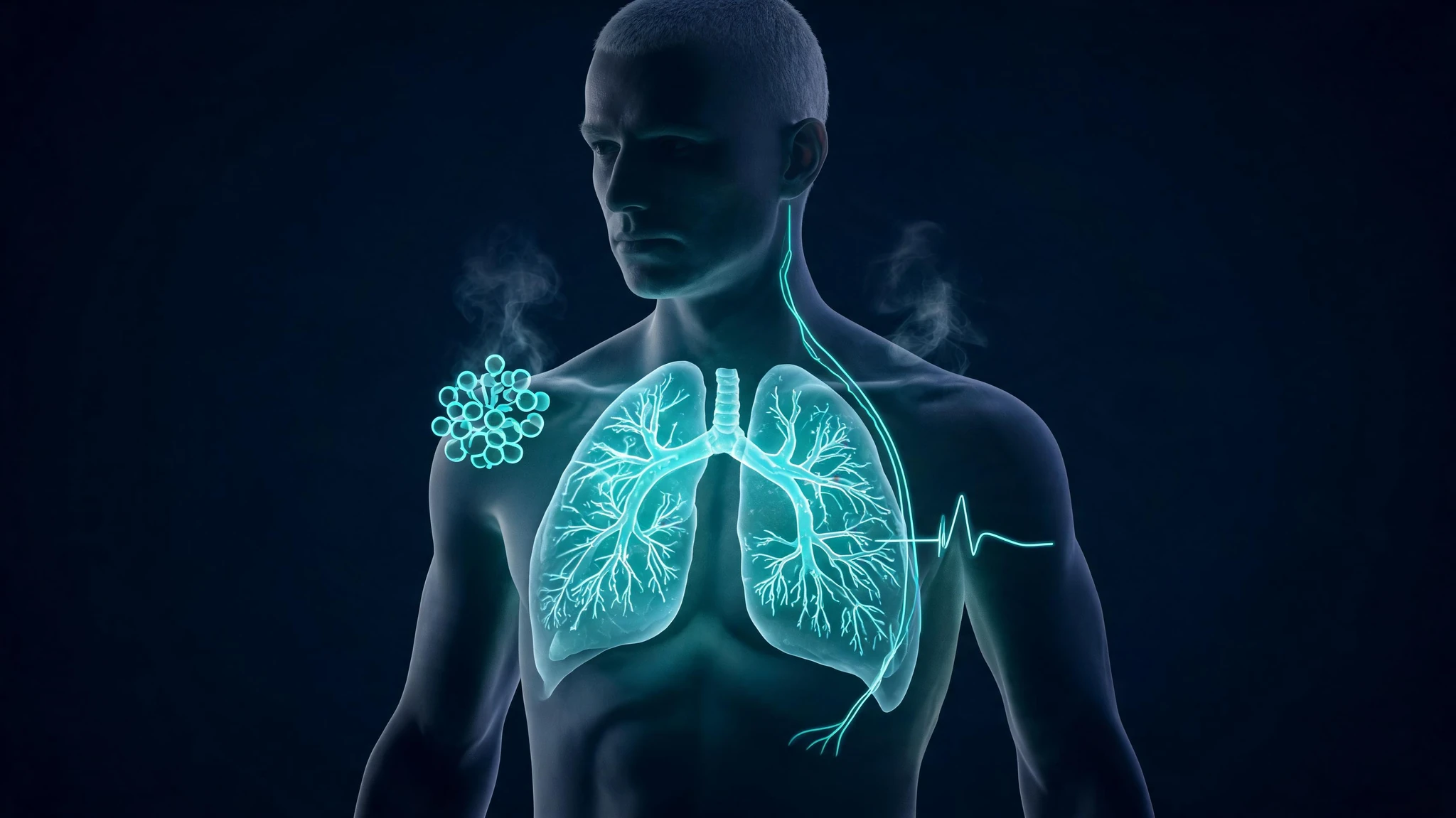
What separates this from a generic deep-breathing exercise is the second inhale. That extra sip is not decoration. It nudges open small air sacs called alveoli that tend to deflate when you sit still and breathe shallowly at a desk all day. Reopening them improves the surface area available for gas exchange, which in turn changes the chemistry of the next exhale.
Why a longer exhale matters
Your autonomic nervous system has two opposing branches. The sympathetic branch handles fight-or-flight. The parasympathetic branch handles rest-and-digest. The two trade dominance with every breath you take. On the inhale, sympathetic activity rises slightly and your heart speeds up. On the exhale, parasympathetic activity rises and your heart slows. This is the engine behind heart rate variability, or HRV, which is one of the cleanest physiological signals of how well your body is recovering.
When you make the exhale longer than the inhale, you tilt the average across that cycle toward the parasympathetic side. A 2017 study by Patrick Steffen and colleagues at Brigham Young University tested resonance-frequency breathing, a slow-paced practice that runs around six breaths per minute, and saw measurable gains in HRV and mood after a single 20-minute session.3 A broader 2018 systematic review by Andrea Zaccaro and colleagues at the University of Pisa pulled together 15 studies on slow breathing and concluded that paced patterns with extended exhales reliably increase parasympathetic tone and reduce markers of arousal.2

Cyclic sighing is shorter and more intense than resonance breathing, but it leans on the same machinery. The double inhale loads the lungs. The slow exhale drives the vagus nerve. Over five minutes, the cumulative effect is a respiratory rate that drifts down and stays there for a while after the practice ends.1
How does it compare to meditation?
This is the part that surprised people. Mindfulness meditation has a deep evidence base. It improves anxiety, reduces rumination, and changes the way the brain responds to emotional cues. It would be reasonable to assume a five-minute meditation session would beat a five-minute breathing drill on a mood outcome.
It did not, at least not in this trial. Across 28 days of daily practice, the cyclic sighing group’s positive-affect scores climbed faster than the mindfulness group’s, and their respiratory rate dropped more.1 The authors are careful to point out that this does not mean meditation is worse. Meditation has long-tail effects on attention and self-awareness that a one-month mood survey will not capture. What the data does suggest is that for the narrow goal of feeling better right now, a structured breathing pattern with a built-in long exhale may move the gauge faster than open-monitoring meditation does.
One reasonable explanation: meditation asks you to do less, and many people find “do less” oddly hard at first. Cyclic sighing gives you something concrete to perform. Inhale, sip, exhale, repeat. You are not fighting the wandering mind, you are giving it a job.
Does the science hold up beyond one paper?
One trial is one trial. The pattern of result, though, fits a larger picture. A 2017 study by Vincenzo Perciavalle and colleagues at the University of Catania measured cortisol and self-reported stress before and after a brief slow-breathing intervention, and found the breathing group’s cortisol dropped while their mood improved.4 A 2017 trial by Xiao Ma and colleagues at the Chinese Academy of Sciences ran an eight-week diaphragmatic breathing program and saw improvements in attention, lower negative affect, and reduced cortisol compared to a control group.5
None of these studies tested cyclic sighing specifically. They tested adjacent practices: slow paced breathing, deep diaphragmatic breathing, resonance breathing. The common thread is the longer exhale and the shift toward parasympathetic dominance. That convergence matters more than any single study, because it suggests the underlying mechanism is real even if the exact protocol that works best is still being argued over.2

If you want to be honest about it, the evidence base is solid for “slow breathing with longer exhales improves short-term mood and HRV” and thinner for “this specific five-minute pattern is the best one.” The Stanford paper is the strongest direct comparison so far, and it favors cyclic sighing. Future studies will sharpen the picture.
What does five minutes a day actually look like?
Set a timer for five minutes. Sit somewhere quiet, or do not. The Stanford participants did this at home, in whatever conditions their lives offered, and the effect still showed up.1 Inhale through the nose, slowly. When your lungs feel full, take a second small inhale on top of that first one. Exhale through the mouth, long and slow, until you have nothing left. Then start again.
That is the whole instruction. There are no postures, no mantras, no counting beads. The pattern is short enough that you will probably get through 25 to 35 cycles in five minutes, depending on how slowly you stretch the exhale.
A few practical notes from people who have tried it longer than the trial ran. The first session can feel slightly dizzy, especially if you are pulling in more air than usual. That fades after two or three sessions as your body recalibrates. Doing it in the morning before email tends to set a calmer baseline for the day. Doing it in the evening tends to help with the racing-thoughts version of insomnia, though the trial did not specifically test sleep.

You can also use it situationally. A short version, even three or four breaths, before a meeting or a difficult conversation, can drop your heart rate enough to notice. This is closer to what your body does spontaneously when it sighs in the middle of a stressful afternoon. You are simply doing it on purpose.
When it might not be the right tool
Breathwork is gentle for almost everyone, but a few caveats are worth saying out loud. People with severe asthma or COPD should clear any new breathing practice with their physician first, especially anything that involves holding the breath or extending the exhale to the point of strain. The cyclic sigh does not involve breath-holding, but it does change CO2 levels, which can feel uncomfortable for people with respiratory conditions.
People with a history of panic disorder sometimes find that any practice involving close attention to the breath can briefly amplify anxiety before it eases. If that happens, slow down, shorten the session, or work with a therapist who can guide you through it. The Stanford trial did not enroll participants with active panic disorder, so the published results may not generalize cleanly to that group.1
And it is worth being clear about what cyclic sighing is not. It is not a treatment for clinical depression or anxiety. It is a low-cost, low-risk practice that may improve daily mood and physiological arousal in healthy adults. If you are in real distress, breathing exercises are a complement to professional care, not a substitute for it.

Why this kind of finding tends to stick
Most viral wellness claims do not survive close inspection. They lean on a single small study, an underpowered effect, and a press release that overstates both. Cyclic sighing is unusual because the published trial is reasonably well-designed, the mechanism is biologically plausible and convergent with decades of HRV research, and the protocol costs nothing to test on yourself.1,2
That last point is the quiet reason these findings spread. You do not need to wait for a meta-analysis to know whether five minutes of intentional breathing changes how you feel. You can run the experiment this afternoon, and your nervous system will tell you what it thinks.
Common questions about cyclic sighing
Is cyclic sighing the same as box breathing?
No. Box breathing uses equal-length inhale, hold, exhale, and hold phases, often four seconds each. Cyclic sighing uses a double inhale and a much longer exhale with no breath-holds. The Stanford trial tested both and saw a larger mood gain from cyclic sighing.1
How fast should I breathe?
There is no fixed pace. Aim for an exhale that is roughly twice as long as the combined inhale and second sip. Most people end up around three to five breaths per minute once they settle in.
Can I do this lying down?
Yes. Sitting and lying both work. Some people find lying on their back makes the diaphragm easier to feel.
How long until I notice anything?
Many people feel slightly calmer after a single session. The Stanford trial measured the strongest effects after about a month of daily practice.1
Will it help me sleep?
The trial did not measure sleep directly. Slower breathing patterns are associated with parasympathetic activation, which is linked to sleep onset, but this is an inference rather than a tested outcome.2,3
Where this leaves us
If you have been looking for a wellness habit that is small enough to actually do, cyclic sighing fits in the gap that meditation often misses. Five minutes is short enough to slot in before a shower or after lunch. The motion is simple enough to remember without an app. And the evidence, while still building, points the same way: a long exhale, repeated, calms the system that runs your stress response.
That is not a cure for anything. It is a small, repeatable lever that most people can pull without buying a thing. Try it for a week. Notice whether your respiratory rate at rest feels different by Friday. Whatever you find will be more useful than another article about it.
Sources
- Balban MY, Neri E, Kogon MM, Weed L, Nouriani B, Jo B, Holl G, Zeitzer JM, Spiegel D, Huberman AD. Brief structured respiration practices enhance mood and reduce physiological arousal. Cell Rep Med. 2023. PubMed: 36630953
- Zaccaro A, Piarulli A, Laurino M, Garbella E, Menicucci D, Neri B, Gemignani A. How Breath-Control Can Change Your Life: A Systematic Review on Psycho-Physiological Correlates of Slow Breathing. Front Hum Neurosci. 2018. PubMed: 30245619
- Steffen PR, Austin T, DeBarros A, Brown T. The Impact of Resonance Frequency Breathing on Measures of Heart Rate Variability, Blood Pressure, and Mood. Front Public Health. 2017. PubMed: 28890890
- Perciavalle V, Blandini M, Fecarotta P, Buscemi A, Di Corrado D, Bertolo L, Fichera F, Coco M. The role of deep breathing on stress. Neurol Sci. 2017. PubMed: 27995346
- Ma X, Yue ZQ, Gong ZQ, Zhang H, Duan NY, Shi YT, Wei GX, Li YF. The Effect of Diaphragmatic Breathing on Attention, Negative Affect and Stress in Healthy Adults. Front Psychol. 2017. PubMed: 28626434