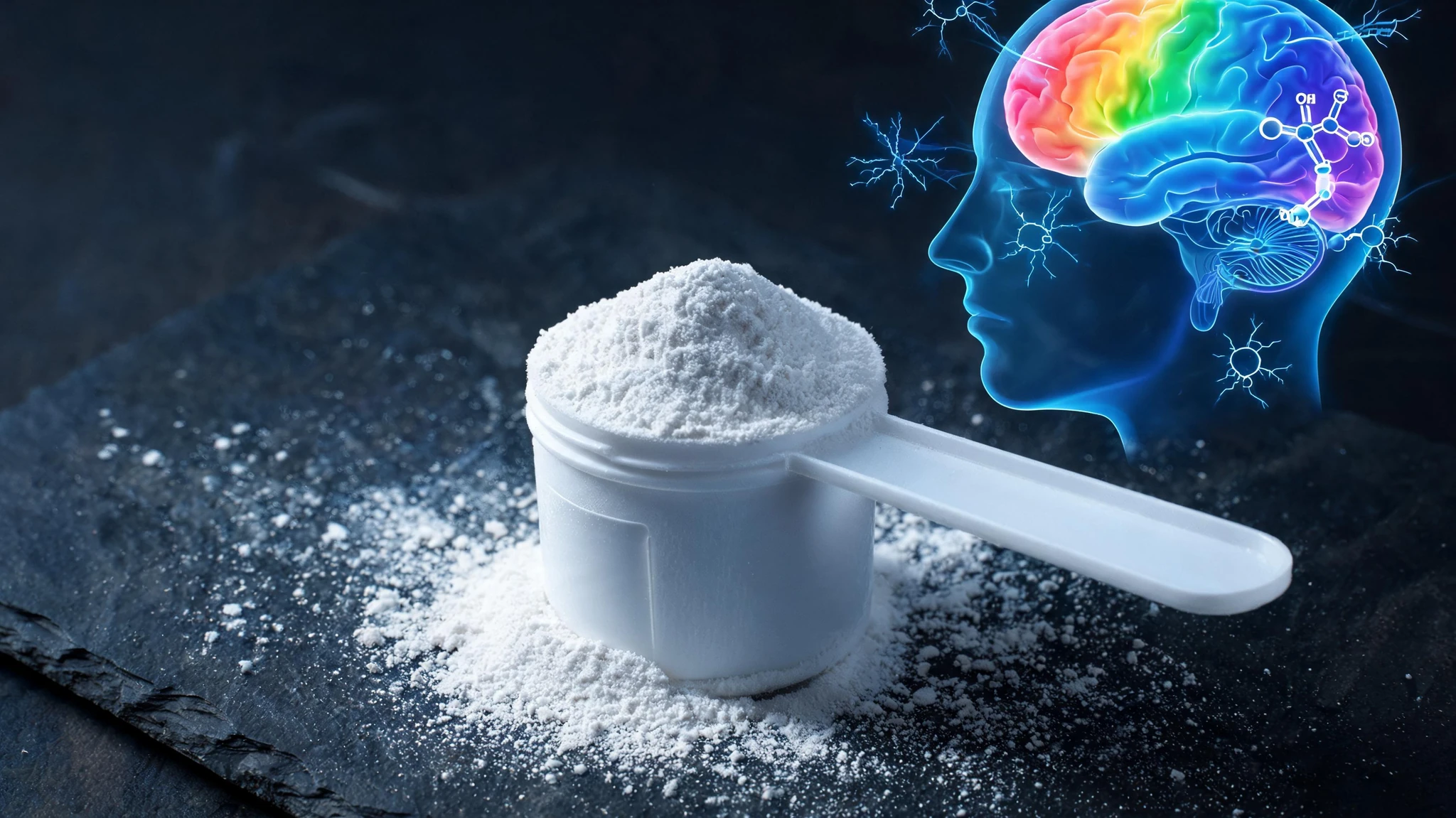
Creatine, the white powder that has lived in gym bags for thirty years, has quietly built a second resume. A growing stack of randomized trials suggests it can nudge memory and mental processing speed in healthy adults, with the clearest gains in older people and in those who don’t get much from food.1 The effects are modest. They are not nothing.
The most-cited review on the topic, published in Experimental Gerontology in 2018 by Avgerinos and colleagues, pooled six randomized controlled trials and concluded that creatine supplementation produced measurable improvements in short-term memory and intelligence/reasoning measures in healthy adults, with older participants benefiting more than younger ones.1 A separate brain-imaging trial back in 2003 had already shown that the supplement raises measurable cognitive performance on demanding tasks.2 The finding the social-media posts keep recycling, that creatine is “not just for muscles,” is, at this point, fair.
What is creatine actually doing in the brain?
Your brain runs on ATP, adenosine triphosphate, the universal cellular battery. ATP gets spent in milliseconds during demanding mental work and has to be regenerated almost as fast. The shuttle that does that regeneration is phosphocreatine, a high-energy molecule that hands a phosphate group back to spent ADP and turns it into fresh ATP. About 95 percent of the body’s creatine sits in skeletal muscle, but the brain has its own pool, and that pool is what supplementation tops up.2
Rae and colleagues at the University of Sydney ran what is still the cleanest demonstration of the brain effect. In their double-blind, placebo-controlled crossover trial, healthy young adults took 5 grams of creatine monohydrate per day for six weeks and then completed a working-memory task and a Raven’s Advanced Progressive Matrices test, which measures fluid intelligence.2 Both scores improved on creatine compared to placebo. Not by enormous margins. By enough to clear statistical significance in a small, well-controlled sample.
What the supplement appears to be doing, then, is raising the energy ceiling under cognition. When the task is easy, you don’t need the extra reserve. When the task is hard, when working memory is loaded or processing speed is being pushed, the bigger phosphocreatine pool buys a little more headroom.
That headroom matters most in conditions where the brain is already working against a deficit. Sleep deprivation is the most-studied stressor, and small trials have suggested that creatine partially blunts the cognitive cost of one bad night. Mental fatigue from extended task performance is another. The pattern across these studies is consistent. Creatine does not make a rested, well-fed person noticeably smarter on easy tasks. It appears to protect performance when the conditions for thinking get harder.

Why older brains seem to gain more
The age effect is one of the more interesting threads in the literature. The 2018 systematic review specifically called out that benefits were larger in older adults than in younger ones, and a 2014 meta-analysis by Devries and Phillips found that creatine combined with resistance training produced significantly greater gains in lean mass and upper-body strength in adults over 50 than placebo did, with no safety signals.1,5
Two things probably explain the pattern. First, brain creatine concentrations decline with age, so a supplement is filling a slightly emptier tank. Second, older adults tend to eat less meat and less of it, which means dietary creatine intake drops at the exact life stage when the brain’s energy economy gets tighter. Plug those two together and you have a setup where supplementation has more to work with.
None of this means creatine reverses age-related cognitive decline. It does not. The effect sizes in the trials are described in the literature as small to moderate, and the tasks that improve are specific. Short-term memory. Processing speed under load. Reasoning on timed tests. The trials do not show an effect on global measures of long-term memory or on diagnoses of dementia, and you should be skeptical of any product that implies they do.
It is also worth being honest about the size of the literature. The 2018 review pooled six trials, which is not a mountain of evidence. Several of the older-adult studies enrolled fewer than fifty participants. The trend across them is in the same direction, which is encouraging, but the case for creatine as a cognition aid in older adults is “promising and plausible,” not “settled.” A reasonable person looking at the file can decide that 3 grams a day of a cheap, well-tolerated supplement is worth trying. A reasonable person can also decide to wait for larger trials. Both reads are defensible.
Vegetarians, vegans, and the people who notice the most
If older adults are one group that responds well, vegetarians are the other. Creatine is found almost exclusively in animal foods, with red meat and fish being the dominant sources. A typical omnivorous diet supplies roughly 1 to 2 grams a day, which the body uses to maintain its ~120-gram total pool. People who eat little or no meat take in much less and generally show lower baseline creatine stores in muscle and brain.
Benton and Donohoe at Swansea University tested whether that gap matters cognitively. They ran a placebo-controlled trial in young adults, comparing vegetarians and omnivores on memory tasks before and after five days of creatine loading at 20 grams per day.3 The vegetarians improved on memory tasks while taking creatine. The omnivores did not show a meaningful change on the same measures. The reasonable read is that you cannot top up a tank that is already close to full, and that people who start lower tend to notice more.

This is the single most actionable piece of evidence in the file. If you eat little or no meat and you do mentally demanding work, creatine is one of the very few well-studied supplements that has a plausible mechanism, a clinical trial behind it, and a safety record long enough to evaluate.
Doses, forms, and the loading-phase question
Across the trials, creatine monohydrate is the form that has been studied most. It is also the cheapest, by a wide margin. Newer forms with names like creatine HCl, ethyl ester, magnesium chelate, and buffered creatine show up on supplement shelves and in marketing copy. None of them have been shown in head-to-head trials to outperform plain monohydrate on either absorption or outcomes.4 The International Society of Sports Nutrition position paper on creatine, published in 2021 by Antonio and twenty-eight co-authors, is unusually direct on this point: monohydrate is the standard, and other forms charge a premium without delivering an advantage.4
Doses cluster around two patterns. The faster pattern is a five-to-seven-day loading phase at roughly 20 grams per day, split into four 5-gram doses, followed by a maintenance dose of 3 to 5 grams per day. The slower pattern skips the load and goes straight to 3 to 5 grams per day, with stores reaching saturation in three to four weeks instead of one. Cognitive trials have used both. Rae’s brain-performance study used 5 grams a day for six weeks with no loading.2 Benton’s vegetarian study used the 20-gram loading protocol over five days.3 Either approach gets you to the same destination.
Timing relative to workouts or meals does not appear to matter much for cognitive outcomes. Take it with food if it bothers your stomach. Some people get mild gastrointestinal discomfort on a full loading dose, which is the main reason a slower ramp can be more comfortable.
What the safety record actually says
Creatine is one of the most-studied supplements in existence. Multi-year trials in athletes have not turned up the kidney damage that early speculation worried about, provided baseline kidney function is normal.4 The ISSN paper walks through the kidney concern carefully and concludes that creatine supplementation at standard doses does not appear to cause renal dysfunction in healthy people. It also notes that creatine elevates serum creatinine, which is a normal byproduct of creatine metabolism, and that this can look like a kidney problem on a blood panel even when nothing is wrong. If you supplement and your doctor orders bloodwork, mention it.
People who already have kidney disease, who are taking nephrotoxic medications, or who are pregnant should talk to a clinician before starting. The same goes for adolescents, where the data is thinner. Beyond those groups, the side-effect profile is mild and dominated by water retention in muscle, which shows up as a small initial weight gain of 1 to 2 kilograms during loading and then stabilizes.

How long does the effect take, and how long does it last?
Cognitive effects in the trials show up on the order of weeks, not days, for people on a slow-ramp protocol. With loading, you can see changes faster, but a single day of supplementation is not going to do anything noticeable. Brain creatine pools turn over slowly compared to muscle, which is one reason chronic dosing matters more than acute timing.
If you stop taking creatine, brain and muscle stores return to baseline over roughly four to six weeks. There is no rebound, no withdrawal, and no evidence of dependence. People who cycle on and off do not appear to gain anything by doing so, and people who take it continuously for years have not shown measurable harm in the studies that have followed them.4
One useful way to test whether it is doing anything for you is to keep a simple log for a month. Note your sleep hours, what you ate, and a rough subjective rating of how clear your thinking felt during the workday. Compare the second half of the month, when stores are saturated, to the first. The signal will be small if it is there at all, and it will be drowned out by sleep and stress before anything else, but a log gives you a chance to see it. Without one, you are mostly guessing.
Common questions about creatine and brain health
Will I notice it?
Some people do, especially vegetarians, older adults, and anyone who is sleep-deprived or under high cognitive load. Many people notice nothing subjective and only see effects on standardized tasks. Both are normal.
Is it the same powder bodybuilders take?
Yes. Creatine monohydrate is creatine monohydrate. Buy a plain, third-party-tested product (look for NSF Certified for Sport or Informed Sport on the label) and skip the flavored, pre-mixed, or “advanced formula” options.
Does coffee or caffeine cancel it out?
Probably not, despite an older study that raised the question. The ISSN review concludes that the evidence does not support a meaningful interference, and most contemporary trials make no effort to separate creatine from caffeine intake.4
Is it safe for women?
Yes. Most early trials were in male athletes, but more recent work shows comparable benefits in women, and the safety profile is the same.4
Can I just eat more steak?
You can raise your levels somewhat, but reaching the doses used in cognitive trials through food alone would mean eating very large amounts of red meat or fish daily. For most people, a 3-to-5-gram scoop is cheaper and easier.
Where this leaves a thoughtful reader
Creatine is not a smart drug, and it is not a dementia preventative. The evidence does not support those framings, and anyone selling them is overreaching. What it appears to be, based on a coherent body of randomized trials over more than two decades, is a cheap, well-tolerated way to raise brain energy reserves a little, with the clearest cognitive gains in people whose baseline stores are low: older adults, vegetarians, and probably anyone running on chronic sleep deprivation.
If you fit one of those groups and you are curious, 3 to 5 grams of plain creatine monohydrate per day is the protocol the literature supports. Give it four to six weeks before deciding whether anything has changed. Pay attention to sleep, food, and movement at the same time, because those still do most of the work, and a supplement that adds a few percent on top of a solid foundation is worth more than one that promises to compensate for its absence.
Sources
- Avgerinos KI et al. Effects of creatine supplementation on cognitive function of healthy individuals: A systematic review of randomized controlled trials. Experimental Gerontology, 2018. PubMed: 29704637
- Rae C et al. Oral creatine monohydrate supplementation improves brain performance: a double-blind, placebo-controlled, cross-over trial. Proceedings of the Royal Society B, 2003. PubMed: 14561278
- Benton D, Donohoe R. The influence of creatine supplementation on the cognitive functioning of vegetarians and omnivores. British Journal of Nutrition, 2011. PubMed: 21118604
- Antonio J et al. Common questions and misconceptions about creatine supplementation: what does the scientific evidence really show? Journal of the International Society of Sports Nutrition, 2021. PubMed: 33557850
- Devries MC, Phillips SM. Creatine supplementation during resistance training in older adults: a meta-analysis. Medicine and Science in Sports and Exercise, 2014. PubMed: 24576864