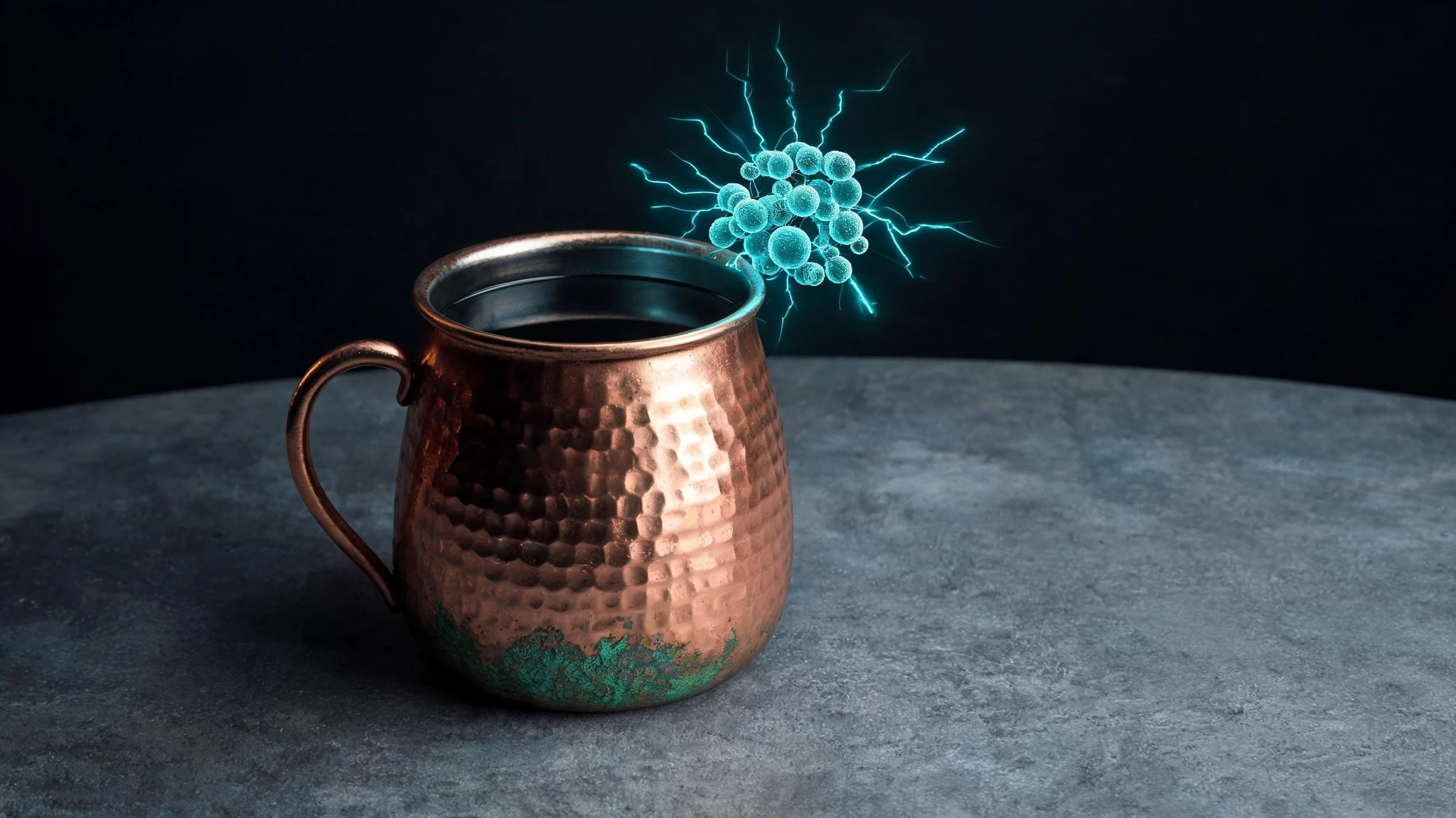
In a 2012 study published in the Journal of Health, Population and Nutrition, researchers in Bangalore deliberately spiked drinking water with diarrhoea-causing bacteria, poured it into traditional Indian copper pots, and walked away for 16 hours. When they came back, they could not recover a single live bacterium of E. coli, Salmonella enterica Typhi, Shigella flexneri, or Vibrio cholerae from the water1. The same water held in glass over the same period stayed contaminated.
That single result is what almost every “copper water bottle” claim on social media traces back to. It is a real finding. It is also narrower than the marketing suggests, and worth understanding properly before you spend $40 on a hammered copper bottle.
What “contact eliminating” actually means
Copper has been used as a water vessel for at least four thousand years, long before anyone knew what a bacterium was. The mechanism behind its antibacterial behavior was only worked out properly in the last two decades, and it has a name: contact eliminating. A 2011 review in Applied and Environmental Microbiology by Gregor Grass and colleagues remains the most cited summary of how it works2.
When a bacterium lands on a metallic copper surface, copper ions begin to leach out and bind to the cell envelope. The membrane starts to lose integrity within minutes. Reactive oxygen species form on the cell surface, the membrane lipids oxidize, and small molecules begin to leak out of the cell. Once the membrane is breached, copper ions flood the cytoplasm, denature proteins, and degrade DNA. The bacterium does not just stop dividing. It comes apart.
A 2012 follow-up paper specifically on copper alloys found that membrane lipid peroxidation, the chemical breakdown of fats in the cell wall, is one of the earliest events in the eliminating process5. That helps explain why the effect is so consistent across different bacterial species. Almost every microbe has a fat-rich outer envelope, and copper attacks that envelope before the bacterium has a chance to mount a defense.

Stainless steel, glass, and ceramic do none of this. They are inert. Bacteria sitting on a stainless steel countertop can survive for days. Bacteria sitting on a clean copper surface usually cannot survive past a few hours. Hospitals in the United Kingdom and the United States have run small trials placing copper alloys on high-touch surfaces in intensive care wards, and the bacterial counts on those surfaces drop by 80 to 90 percent compared with plastic and steel equivalents. The mechanism is the same one Grass and his coauthors describe, just applied to a door handle instead of a drinking pot2.
How long does the effect take?
This is where the social-media version of the story tends to overshoot. Contact eliminating on a dry copper surface, the kind used for hospital door handles and bed rails, can be measured in minutes. Eliminating in stored drinking water is slower, because the bacteria are suspended in liquid and only a fraction of them are touching the metal at any given moment.
The Bangalore team tested several time points. At two hours, bacterial counts had dropped but the water still had recoverable organisms. By 16 hours, the counts were below the limit of detection for all four pathogens1. A separate 2009 paper from the same group, using a copper device dropped into a household water container, found similar results in the 6 to 16 hour window3.
An older 2005 study from Punjab compared traditional brass pots, earthenware, and glass for storing well water that was naturally contaminated with coliforms4. Brass, which is mostly copper alloyed with zinc, reduced coliform counts by more than 99 percent within 48 hours. Earthenware was less effective. Glass was barely effective at all. The authors of that paper were careful to note that the rate depends on temperature, the starting bacterial load, and the surface area of the metal in contact with the water.
So the workable rule, supported by the evidence, is somewhere in the 16 to 48 hour range. Eight hours overnight is probably not enough for heavily contaminated water. A full day and night usually is.
Is it safe to drink copper-stored water every day?
The Bangalore researchers measured copper levels in the water at the same time points where they were measuring bacterial counts. After 16 hours of storage, the dissolved copper sat at roughly 0.21 milligrams per liter1. The World Health Organization’s permissible limit in drinking water is 2 milligrams per liter, almost ten times higher. So in that experiment, the water was both bacteriologically clean and well within the safety margin.
The longer you store water in copper, however, the more copper leaches in. Push past 48 hours, especially with acidic water or in a warm room, and concentrations climb. Acute copper toxicity from drinking water is rare but documented, and it tends to show up first as nausea, abdominal cramping, and a metallic taste. People with Wilson’s disease, a genetic condition that prevents the body from clearing copper properly, should not use copper vessels at all.

For everyone else, the practical guidance from the Indian studies is simple. Fill the pot at night. Drink the water in the morning. Empty whatever is left, rinse, and refill. Do not let water sit for days at a time, and do not store anything acidic, like lemon water or fruit juice, in copper for hours on end. Acid pulls copper out of the metal much faster than neutral water does, sometimes by a factor of ten or more, and that is how people occasionally end up with a stomach ache from a wellness habit they thought was harmless.
Pregnant women, people with chronic liver disease, and anyone on copper-containing supplements should treat copper-stored water as one part of a daily total rather than something to drink in unlimited quantity. A single glass in the morning is well within margins. A liter spread through the day, every day, is worth a conversation with a doctor if any of those conditions apply.
What copper does not do
The wellness industry has taken a real and rather narrow finding about contaminated water and stretched it into a long list of claims that the evidence does not support. Copper-stored water is not a detoxifier in any meaningful biochemical sense. It does not balance the doshas in any way that has been measured in a laboratory. It does not boost immunity, smooth wrinkles, or improve thyroid function.
The copper that does dissolve into the water is real, and small amounts of dietary copper are essential. The recommended daily allowance for adults is 900 micrograms, and most people get that easily from foods like shellfish, organ meats, nuts, seeds, and dark chocolate. Drinking from a copper vessel adds a modest top-up, perhaps 100 to 300 micrograms in a glass that has sat overnight. That is not nothing, but it is also not the limiting nutrient for most healthy adults.
The honest summary is that copper vessels do one thing well: they reduce the bacterial load of stored water that may have been contaminated. In a household with reliably treated tap water, that benefit is small. In a household where the water source is questionable, it is meaningful. The 2012 paper was written with rural Indian communities in mind, where waterborne diarrhoeal disease still wipes out children, and where a copper pot at home is a low-cost intervention with a measurable effect1.
Does the type of copper matter?
It does, more than most product pages let on. The studies that show clean antimicrobial effects use unlined, food-grade copper. Many modern copper bottles sold for fashion and gifting are lined on the inside with stainless steel or food-safe lacquer, which keeps the warm metallic look on the outside but completely blocks the contact-eliminating surface from touching the water. A lined bottle is just a stainless steel bottle with a copper exterior. There is no antimicrobial benefit.
If the inside is matte, slightly orange, and develops a darker patina over time, you have raw copper. If the inside is mirror bright in a way that never tarnishes, it is almost certainly lined. The product description should say. If it does not, assume lined.
Brass works too, as the 2005 Punjab study showed4, and is often cheaper. The downside of brass is that it can also leach small amounts of zinc and, in poor-quality alloys, lead. Stick with reputable suppliers and food-grade certification if you go the brass route.

Cleaning matters more than people think
A copper vessel works because of the chemistry happening at its inner surface. Coat that surface in a layer of mineral scale, biofilm, or oxidation, and you blunt the effect. The traditional Indian cleaning method, half a lemon dipped in coarse salt and rubbed across the inside, is genuinely good practice. The acid strips the patina, the salt provides abrasion, and the surface goes back to clean copper.
Avoid steel wool, which leaves micro-scratches that bacteria can hide in. Avoid bleach, which oxidizes copper aggressively and can pit the surface. A weekly scrub with lemon and salt is enough for daily-use vessels. Once a month, give it a longer soak with a tablespoon of vinegar in warm water and a final rinse.
If your copper bottle smells metallic or the water tastes off, that is usually a sign of oxidation buildup rather than spoilage. Clean it and refill. If the taste persists, the bottle may be lined and damaged, in which case you should retire it.
Common questions about copper water
How long should I leave water in a copper pot before drinking?
Eight to sixteen hours is the practical sweet spot. Overnight works for most households. Twelve hours is plenty if the starting water is already clean.
Can I boil water in a copper vessel?
You can, and people have for centuries, but heat speeds up copper leaching. For daily drinking water, room-temperature storage is safer and gives you the antimicrobial effect without pushing copper levels up.
Does it matter if I refrigerate copper-stored water?
Cold slows the contact-eliminating effect. The Bangalore work was done at room temperature, around 25 degrees Celsius, which is where copper performs best1. Refrigerate the water after the storage period, not during it.
Will it work for tap water that is already chlorinated?
If your tap water is already safe, copper adds little. The effect shows up most clearly when the water has bacterial contamination to begin with. There is no harm in using a copper vessel with treated water, but the bacterial benefit is small.
Can children use copper water bottles?
In moderation, yes, with the same overnight storage rule. Children weigh less, so the same dose of copper is proportionally larger for them. Limit to one copper-stored glass a day for kids under twelve, and use stainless steel or glass for the rest of their fluid intake.
Where this leaves the wellness claim
Copper water bottles are not a scam, and they are not a miracle. They sit in a smaller and more useful category, which is old practical technology that turns out to have a defensible scientific basis. The contact-eliminating mechanism is real, the published time-course is reproducible across labs, and the safety margin under normal use is wide. None of that translates into the broader health claims that have attached themselves to the practice over the last decade of social media.
If you already have safe drinking water, a copper bottle is a small upgrade with a small benefit. If your water source is uncertain, it is a cheap, durable, and well-studied piece of kitchen equipment that has been quietly doing useful work in households for thousands of years. Buy unlined copper. Clean it with lemon and salt. Fill it before bed. The science, narrow as it is, will hold up.
Sources
- Sudha VB, Ganesan S, Pazhani GP, Ramamurthy T, Nair GB, Venkatasubramanian P. Storing drinking-water in copper pots wipes out contaminating diarrhoeagenic bacteria. J Health Popul Nutr. 2012;30(1):17–21. PubMed: 22524115
- Grass G, Rensing C, Solioz M. Metallic copper as an antimicrobial surface. Appl Environ Microbiol. 2011;77(5):1541–1547. PubMed: 21193661
- Sudha VB, Singh KO, Prasad SR, Venkatasubramanian P. Eliminating of enteric bacteria in drinking water by a copper device for use in the home: laboratory evidence. Trans R Soc Trop Med Hyg. 2009;103(8):819–822. PubMed: 19230946
- Tandon P, Chhibber S, Reed RH. Inactivation of Escherichia coli and coliform bacteria in traditional brass and earthernware water storage vessels. Antonie van Leeuwenhoek. 2005;88(1):35–48. PubMed: 15928975
- Hong R, Kang TY, Michels CA, Gadura N. Membrane lipid peroxidation in copper alloy-mediated contact eliminating of Escherichia coli. Appl Environ Microbiol. 2012;78(6):1776–1784. PubMed: 22247141