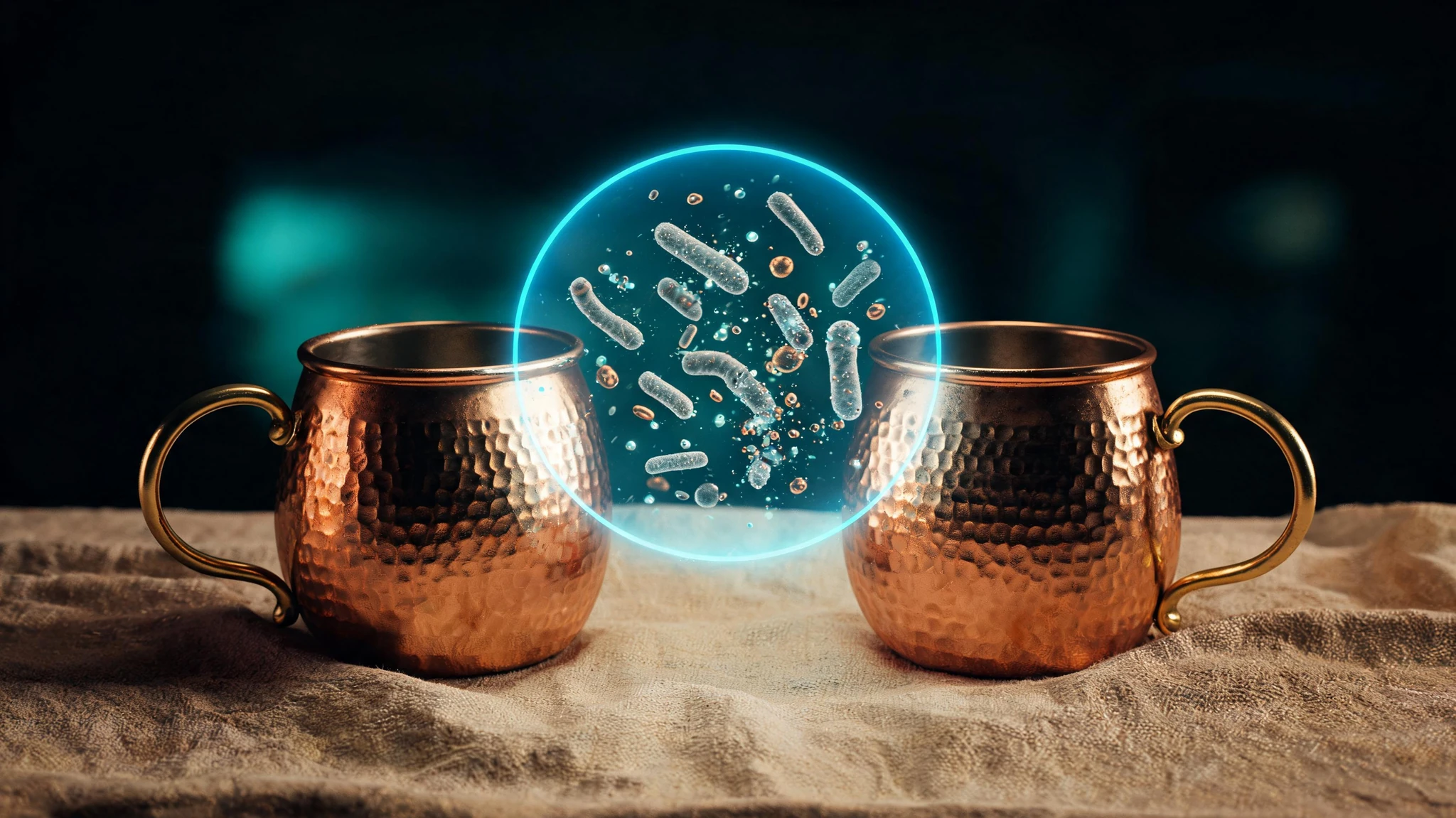
Water stored in a copper vessel for sixteen hours had no recoverable E. coli, Vibrio cholerae, or Salmonella Typhi at the end of the study period. That finding came out of a 2012 paper by Sudha and colleagues in the Journal of Health, Population, and Nutrition, where the team deliberately spiked drinking water with diarrhea-causing bacteria and watched what copper did to it.1
The numbers across their experiments ranged from an 88.9% reduction in some short windows to total clearance in others, depending on the species and the storage time. It is not folklore. It is a small, tightly-scoped microbiology paper. The interesting question is what it actually proves, and what people are reading into it that it does not.
What is the oligodynamic effect, exactly?
The word sounds invented. It is not. “Oligodynamic” comes from a 19th-century Swiss botanist named Karl Wilhelm von Naegeli, who noticed that very small amounts of certain metals (silver, copper, zinc, mercury) eliminated algae in his lab water. The Greek roots translate roughly to “active in tiny quantities.”
In modern terms, the oligodynamic effect refers to the antimicrobial activity of metal ions at concentrations far below what would harm most plants or animals. Copper is one of the strongest performers in this category, and it has been studied repeatedly since the early 2000s as a candidate for antibacterial surfaces in healthcare and water storage.4
When water sits in contact with copper, a small amount of the metal dissolves into the water as ions, mostly Cu(I) and Cu(II). These charged copper atoms are what do the actual eliminating. The metal cup is a slow, steady ion source, which is why time matters more than agitation in this process.
How copper ions actually wipe out bacteria
The mechanism is well-described in the literature, and Grass, Rensing, and Solioz laid it out clearly in their 2011 review.4 Three things happen, often at once.
First, copper ions disrupt the bacterial cell membrane. They bind to thiol groups (sulfur-containing parts of certain amino acids) in membrane proteins, which destabilizes the lipid bilayer and causes leakage. The cell starts to lose its internal contents. Second, copper triggers oxidative stress inside the cell by generating reactive oxygen species through Fenton-type chemistry. This damages proteins and lipids that the bacterium needs to function. Third, copper appears to fragment bacterial DNA, although this seems to happen mostly after the cell is already inactivating.5

The combined effect is that bacteria do not develop resistance to copper the way they do to many antibiotics. Resistance to a chemical compound usually involves the cell making one specific countermove, like an enzyme that breaks the drug down. There is no clean countermove against “your membrane is leaking, your proteins are oxidizing, and your DNA is fragmenting at the same time.”
Quaranta and colleagues looked at the closely-related question of how copper wipes out yeast cells on dry metallic copper surfaces, and found a similar multi-pronged attack pattern.5 The dry-surface case is interesting because it removes the “ions in solution” pathway and shows that direct contact alone is enough.
What the Indian study actually tested
Sudha and the team at the Foundation for Revitalisation of Local Health Traditions in Bangalore designed a clean little experiment. They took drinking water and spiked it with three pathogens that cause large amounts of childhood diarrhea worldwide: enterotoxigenic Escherichia coli, Vibrio cholerae, and Salmonella Typhi. Initial bacterial loads were on the order of 500 colony-forming units per milliliter.1
They poured this contaminated water into copper pots and into glass bottles as controls, then sampled at intervals over sixteen hours. In the copper pots, all three bacteria were below the detection limit by the end of the study window. In the glass controls, the bacteria were still happily there. The copper concentration in the water at sixteen hours was 0.20 milligrams per liter, which is well under the World Health Organization’s drinking-water guideline of 2 milligrams per liter.
The authors framed the result modestly. Their suggestion was that in low-resource settings without reliable water treatment, storing drinking water overnight in a copper vessel could meaningfully reduce the burden of waterborne diarrheal disease. They did not claim it cured anything, fixed thyroids, slowed aging, or prevented cancer. Those claims showed up later, on the internet.

The hospital surface studies are a separate finding
Two pieces of research often get mixed into copper-cup posts even though they are studying something else entirely. Salgado and colleagues published a multi-center trial in 2013 across three U.S. ICUs, replacing six commonly-touched surfaces (bed rails, over-bed tables, IV poles, nurse call buttons, the chair arms in patient rooms, and a workstation rail) with copper alloys.2 Patients in rooms with copper surfaces had a hospital-acquired-infection rate of 0.034 per patient-day, compared with 0.081 in standard rooms. That is a reduction of about 58%, not the 40% number that gets quoted around social media.
Schmidt and the same research group published a parallel paper showing that the microbial burden on those copper surfaces stayed roughly 83% lower than the burden on the comparable plastic, wood, and laminate surfaces in standard rooms, sustained over many months.3 The implication is that copper kept working even with people touching it constantly, with no special cleaning protocol added.
Worth saying clearly: those results are about touched surfaces, not water. The mechanism overlaps (copper ions, contact, oxidative attack) but the situation is different. A copper bed rail is eliminating bacteria that someone’s hand just put there, in a contact-time of seconds to hours. A copper cup is eliminating bacteria suspended in water it is sitting in for many hours.

What the social-media version gets wrong
Search the phrase “copper cups benefits” and you will find lists that include cognitive enhancement, thyroid regulation, joint pain relief, weight loss, anti-aging, and cancer prevention. Almost none of that survives contact with the peer-reviewed literature.
Copper is an essential trace mineral. The body needs about 900 micrograms a day for adults to make connective tissue, run several enzymes, and absorb iron correctly. Frank copper deficiency is real but rare in people eating ordinary diets, since shellfish, organ meats, nuts, seeds, dark chocolate, and whole grains all contain meaningful copper. Drinking water from a copper vessel adds maybe a few hundred micrograms a day, so it is a contributor, not a savior.
“Boosts cognitive function” usually traces back to copper’s role in brain enzymes, which is real but does not mean a deficient brain gets fixed by extra cup-water, or that a normal brain runs faster. “Regulates thyroid function” is a stretch built on the fact that some thyroid enzymes use copper as a cofactor. There are no clinical trials showing that drinking copper-stored water moves thyroid hormone levels in healthy people. “Slows aging” and “lowers cancer risk” have no good evidence behind them at all in this context. Copper is involved in oxidative stress in the body, which is a double-edged thing: too little copper and you cannot run antioxidant enzymes properly, but too much copper and you are generating reactive oxygen species, which is the same process that helps wipe out bacteria in the cup.
How much copper is too much?
This is the part the marketing skips. Copper toxicity is uncommon but not theoretical. The U.S. Institute of Medicine sets a tolerable upper intake level of 10 milligrams a day for adults. The WHO drinking-water guideline of 2 milligrams per liter exists for a reason.
Acute symptoms of too much copper start with nausea, vomiting, abdominal cramps, and diarrhea. Chronic excess can affect the liver. People with Wilson’s disease, a genetic disorder that prevents normal copper excretion, should avoid copper-stored water entirely and ideally talk to a doctor before changing anything about copper exposure. Children are more sensitive than adults.
The Sudha study measured 0.20 milligrams of copper per liter after sixteen hours, which is reassuring for short overnight storage in a clean copper vessel. Storage that goes on for days, especially in pots that are tarnished or corroded, can release more. So can acidic liquids; you do not want to store lemon water, tomato juice, or fermented drinks in a bare copper container, because acid pulls metal into solution faster.

Practical points if you want to try it
People who actually do this often follow a few simple rules. Use water you would otherwise be willing to drink, not visibly contaminated water from an unknown source. Copper handles bacterial pathogens reasonably well in the studies, but it does not remove parasites like Giardia or Cryptosporidium, and it does not remove chemical contaminants such as lead, pesticides, or industrial runoff. It is not a substitute for filtration in places where those are the real problems.
Store water for somewhere between six and sixteen hours, then drink it within a day. Use a vessel that is unlined copper on the inside (a lot of decorative “copper” mugs are nickel- or tin-lined for safety, which means the antibacterial effect does not happen). Clean the vessel regularly with a mild acid like lemon and salt, then rinse well; this removes the green copper-oxide patina that builds up over time. If the vessel pits, corrodes, or develops a strong metallic smell, replace it.
Skip it during pregnancy unless your doctor says otherwise, since prenatal copper status is delicate. Skip it for infants. And do not stack it on top of a copper supplement; the supplement plus the cup plus a normal diet can push you past the upper limit.
One small detail that is easy to miss: the antibacterial action depends on the water actually touching the metal. A glass liner, a thick patina layer, or a plastic insert all break the chain. So does pouring the water back and forth between vessels every few hours, since the bacteria you are trying to wipe out need time in contact with copper ions to become inactive. Set the cup down. Walk away. Come back tomorrow morning. The boring approach is the one that matches what the studies tested.
Common questions about copper cups and water
Does copper-stored water taste different?
Slightly. People often describe a faint metallic edge that gets stronger the longer the water sits. Some find it pleasant, others do not.
How long should water sit before the antibacterial effect kicks in?
The Sudha experiments showed measurable reductions inside a few hours and full clearance by sixteen hours under their conditions. Overnight storage is a reasonable practical target.
Can I store boiling-hot water in a copper cup?
You can, but the cup gets very hot to the touch and hot water increases ion release. Cool, room-temperature storage is what the studies tested.
Will copper wipe out viruses too?
Some lab work suggests copper surfaces inactivate certain viruses, but the in-water evidence for everyday viruses is much thinner than the bacterial evidence. Do not rely on a copper cup to protect against a virus.
Are copper water bottles the same as copper cups?
Functionally similar if both are unlined inside. Bottles with internal coatings or stainless-steel liners do not produce the antibacterial effect.
Where this leaves us
The scientific case for copper as an antibacterial surface is solid. There are real lab studies showing real reductions in real pathogens, both in stored water and on touched hospital surfaces. The mechanism is understood. The toxicity ceiling, in normal daily use, is well above where careful copper-cup users land.
What the science does not say is that a copper cup is a wellness device. It does not unblock your thyroid, lift your mood, or rejuvenate your skin from the inside out. It is a low-tech tool for reducing bacterial load in stored drinking water, with a small bonus dose of an essential mineral. That is a genuinely useful thing in some contexts and a mostly-symbolic thing in others. Knowing which one you are buying changes how much you should pay for it, and how much you should expect from it.


Sources
- Sudha VB, Ganesan S, Pazhani GP, Ramamurthy T, Nair GB, Venkatasubramanian P. Storing drinking-water in copper pots wipes out contaminating diarrhoeagenic bacteria. Journal of Health, Population, and Nutrition, 2012. PubMed: 22524115
- Salgado CD, Sepkowitz KA, John JF, Cantey JR, Attaway HH, Freeman KD, Sharpe PA, Michels HT, Schmidt MG. Copper surfaces reduce the rate of healthcare-acquired infections in the intensive care unit. Infection Control and Hospital Epidemiology, 2013. PubMed: 23571364
- Schmidt MG, Attaway HH, Sharpe PA, John J Jr, Sepkowitz KA, Morgan A, Fairey SE, Singh S, Steed LL, Cantey JR, Freeman KD, Michels HT, Salgado CD. Sustained reduction of microbial burden on common hospital surfaces through introduction of copper. Journal of Clinical Microbiology, 2012. PubMed: 22553242
- Grass G, Rensing C, Solioz M. Metallic copper as an antimicrobial surface. Applied and Environmental Microbiology, 2011. PubMed: 21193661
- Quaranta D, Krans T, Espirito Santo C, Elowsky CG, Domaille DW, Chang CJ, Grass G. Mechanisms of contact-mediated eliminating of yeast cells on dry metallic copper surfaces. Applied and Environmental Microbiology, 2011. PubMed: 21097600