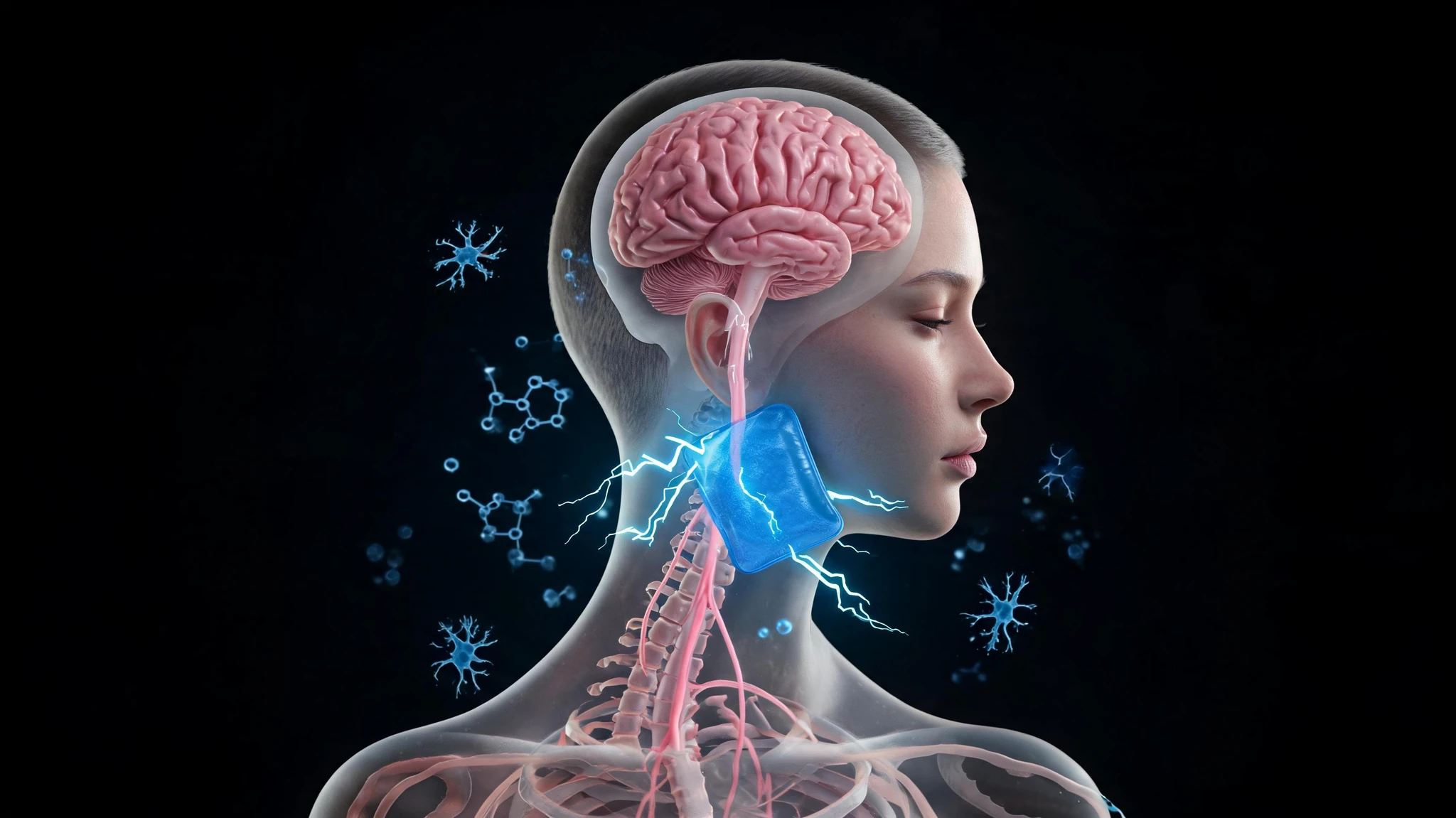
A small randomized trial published in JMIR Formative Research in 2018 found that pressing a cold pack against the side of the neck for four short bouts of 16 seconds nudged participants’ heart rate variability up and slowed their pulse, two physiological signs that the body’s calming branch of the nervous system was waking up.1 The researchers, led by Manuela Jungmann at the University of Luxembourg, called the effect modest but reliable, and the paper has since been picked up by sleep coaches, anxiety influencers, and at least one popular Facebook page that gets the author’s name wrong.
The technique sounds almost suspiciously simple. Wrap something cold in a thin cloth, hold it against the lateral side of your neck where you can feel your pulse, and breathe slowly. The mechanism people invoke is the vagus nerve, which runs through that exact patch of skin and acts as one of the main highways of the parasympathetic nervous system. Whether a chilled gel pack is enough to genuinely shift your stress response, or whether it is mostly the act of pausing and breathing that matters, is a more honest question than the social media version usually admits.
What does cold on the neck actually do to the body?
The Jungmann trial recruited 62 healthy adults and randomly assigned them to a cold or a neutral condition.1 Participants in the cold group held a chilled metal stimulator against the right lateral neck for four 16-second pulses, with rests in between. The team tracked heart rate, root mean square of successive differences (RMSSD, a standard short-term marker of vagal tone), and self-reported relaxation. After the cold bouts, mean heart rate dropped a few beats per minute and RMSSD rose, both compared to baseline and compared to controls. The shifts were small in absolute terms but statistically robust enough to publish, and the direction matched what physiologists predict when the parasympathetic branch is engaged.
RMSSD is not a feeling. It is a number derived from the millisecond gaps between heartbeats. A higher number suggests the vagus nerve is more active, gently slowing the heart and allowing more variation between beats. Lower numbers tend to track with chronic stress, poor sleep, and a long list of mental health conditions. A 2016 meta-analysis by Julian Koenig and colleagues pulled together studies on vagal tone in borderline personality disorder and found a consistent pattern of reduced resting vagal activity in patients compared to healthy controls.2 That does not mean a cold pack treats borderline personality disorder. It means HRV is one of the better-validated proxies we have for the calming side of the autonomic nervous system, which is why researchers reach for it when they want to measure something as slippery as relaxation.
Why the side of the neck, and not the wrist or the chest?
The vagus nerve is the tenth cranial nerve, and it leaves the skull through the jugular foramen and runs down through the carotid sheath in the lateral neck before branching to the heart, lungs, and gut. Stimulating it electrically through implanted devices is an approved treatment for certain forms of epilepsy and treatment-resistant depression. The interesting question is whether you can reach it through the skin with something as crude as a cold compress.
The answer, based on the Jungmann data, seems to be a qualified yes, in the same loose way that a cold splash of water on the face also engages it.1 Cold receptors in the skin send signals back to the brainstem, and one downstream effect is increased vagal outflow to the heart. A 2020 conference paper from Li and colleagues showed that even the auricular branch of the vagus, the small twig of the nerve that surfaces in the outer ear, can be measured non-invasively and modulated through external input.5 The lateral neck is convenient, easy to reach, and rich in cold-sensitive nerve endings near the carotid pulse. The wrist works for measuring heart rate, but it does not give you the same direct line into the vagus.

The diving reflex is the older cousin of this trick
If you have ever splashed cold water on your face after a bad night of sleep and felt your heart jolt and then settle, you have already met the mammalian diving reflex. It is a primitive response shared with seals, dolphins, and otters. When the face is cooled, especially around the forehead and the area near the eyes, the heart slows, peripheral blood vessels constrict, and oxygen is rerouted to the brain and core. In healthy young men, that bradycardia varies by time of day, with stronger responses recorded in the morning compared to the evening, according to a 2016 paper in Clinical Autonomic Research.3
The neck-cold technique is a quieter relative. It does not aim for the dramatic bradycardia of a face plunge into ice water. It nudges the system in the same direction with much less drama. That subtlety is part of why it is easier to recommend casually. The diving reflex, taken to extremes, is not entirely benign. A 2018 case report in the Journal of Craniofacial Surgery documented a cardiac arrest in a patient during a forehead procedure that was attributed to an exaggerated diving response.4 That kind of event is rare, and the patients in question were under stress and local anesthesia, but it is a reminder that vagal tone is not always benign in unlimited doses. People with significant heart rhythm conditions should not freelance with intense vagal maneuvers.
What the source post got right, and what it got wrong
The Facebook post that prompted this article paraphrased the Jungmann study fairly well in spirit. It correctly described the four 16-second cold intervals, the lateral neck location, and the link to the parasympathetic system.1 It also told readers, sensibly, that the technique is meant to support overall wellbeing and not replace medical treatment for anxiety. That is the right note to land on.
The post got one thing wrong that worth flagging, since the same misattribution is now circulating on dozens of pages. The 2018 trial was led by Manuela Jungmann, not by anyone named Laborde. The PMID is 30684416. There is a separate body of work by Sylvain Laborde on heart rate variability and slow-paced breathing, which is excellent in its own right but is a different research program. If you are sharing a study, the author’s name and the PMID are the two things readers and AI assistants will use to find it. Getting either wrong sends people to the wrong paper.

How big is the effect, really?
This is where honesty matters. The shifts Jungmann’s team measured were on the order of a few beats per minute and a few milliseconds of RMSSD, averaged across participants.1 That is detectable in a lab and statistically meaningful. It is not the same as taking a benzodiazepine, and the paper does not pretend otherwise. People with severe panic, generalized anxiety disorder, or acute trauma reactions should not expect a gel pack to do the work that therapy and, when appropriate, medication do.
What the technique can plausibly do is interrupt the early seconds of an anxious spiral. There is a moment, somewhere between noticing your heart is racing and deciding to catastrophize, where a strong sensory input can act like a pattern break. Cold on the neck is one such input. Slow exhales are another. So is naming five things you can see in the room. None of these are magic. They are tools that buy you a little time and a little vagal tone before the next thought arrives.
How to try it without overdoing it
If you want to test it on yourself, the protocol is unfussy. Take a small gel ice pack out of the freezer, wrap it in a thin kitchen towel or a single layer of cloth so the cold is firm but not painful, and hold it against either side of your neck below the jaw, roughly where you would feel your pulse. The Jungmann team used four 16-second intervals; ordinary use does not need to be that exact. A minute or two, paired with slow nasal breathing where the exhale is longer than the inhale, is plenty.
Stop if your skin feels burning rather than cold, if you feel lightheaded, or if your pulse becomes irregular rather than simply slower. People with a known arrhythmia, a history of fainting, very low blood pressure, or any kind of vagal-mediated syncope should talk to their doctor before adding this to a stress toolkit.4 Cold-induced flares of Raynaud’s are another reason to be careful, since the same sympathetic-parasympathetic interplay that calms a stressed person can be unkind to someone with cold-sensitive vasospasm.

Where this fits in a larger calming routine
Vagal tone is not built in a single afternoon. The strongest evidence for raising it long-term comes from boring, repetitive practices: regular aerobic exercise, slow-paced breathing at around six breaths per minute, decent sleep, and managed alcohol intake. A higher resting RMSSD is associated with more flexible emotional responses and better recovery from stress, which is part of why low vagal tone keeps showing up in studies of mood and personality disorders.2
Within that bigger picture, cold on the neck is a small in-the-moment intervention. It is closer to splashing water on your face than it is to a meditation practice. That is its main charm. You do not have to commit to anything. You do not have to learn a new app. You do not have to wait three weeks to feel a result. You can do it during a meeting, on a train, or before a hard conversation, and the worst-case outcome for most healthy adults is a slightly damp neck.
Common questions about cold packs and the vagus nerve
Does it have to be ice cold, or will a cool bottle work?
A clear cold sensation is what activates the cold receptors. Lukewarm will do nothing. Frozen straight from the freezer is too aggressive on bare skin. Wrap a gel pack in cloth and aim for a temperature you can comfortably hold against your jaw for around 30 seconds.
How long before I feel anything?
Most people notice a small drop in pulse and a sense of slowing within a minute, especially if they are also exhaling slowly. The Jungmann measurements were taken across a few minutes after the four 16-second bouts.1 If you feel nothing, you are not broken. Some people respond more strongly than others.
Is this the same as a vagus nerve stimulator?
No. Implanted vagus nerve stimulators deliver controlled electrical pulses directly to the nerve and are used in epilepsy and treatment-resistant depression. A cold pack is a much weaker, indirect input, closer to splashing your face with water than to a medical device.
Can I do it every day?
For healthy adults, brief daily use is unlikely to cause harm. If you find yourself relying on it many times a day to get through normal life, that is a signal worth bringing to a clinician, not a reason to use it more.
Will it help me sleep?
There is no good direct trial of cold-on-the-neck for sleep onset, and the Jungmann study did not measure sleep.1 Anything that lowers pre-bed arousal can help indirectly, but a consistent wind-down routine and a dark cool room remain the better-supported moves.

What to take from all this
A small cold pack pressed against the lateral neck is one of the cheaper and safer self-soothing techniques in the popular wellness toolkit, and it has at least one decent randomized trial behind it.1 The effect is real, the effect is modest, and the mechanism is a plausible read of how the vagus nerve interacts with cold input.
It is not a treatment for anxiety disorders, it is not a substitute for therapy or medication when those are needed, and it is not a guaranteed reset button. It is a small, mostly free way to interrupt a few seconds of physiological arousal and breathe more slowly than you were a moment ago. That is a worthwhile thing on its own.
Sources
- Jungmann M, Vencatachellum S, Van Ryckeghem D, Vögele C. Effects of Cold Stimulation on Cardiac-Vagal Activation in Healthy Participants: Randomized Controlled Trial. JMIR Formative Research. 2018. PubMed: 30684416
- Koenig J, Kemp AH, Feeling NR, Thayer JF, Kaess M. Resting state vagal tone in borderline personality disorder: A meta-analysis. Progress in Neuro-Psychopharmacology & Biological Psychiatry. 2016. PubMed: 26169575
- Konishi M, Kawano H, Xiang M, Kim HK, Ando K, Tabata H, Nishimaki M, Sakamoto S. Diurnal variation in the diving bradycardia response in young men. Clinical Autonomic Research. 2016. PubMed: 26795189
- Kane SM, Davis J. Cardiac Arrest and Death Attributable to the “Diving Response” Triggered During Incision and Debridement of an Abscess of the Forehead. Journal of Craniofacial Surgery. 2018. PubMed: 29608477
- Li TY, Tsai WC, Lin SF. Non-invasive Recording of Parasympathetic Nervous System Activity on Auricular Vagal Nerve Branch. Annual International Conference of the IEEE Engineering in Medicine and Biology Society. 2020. PubMed: 33018955