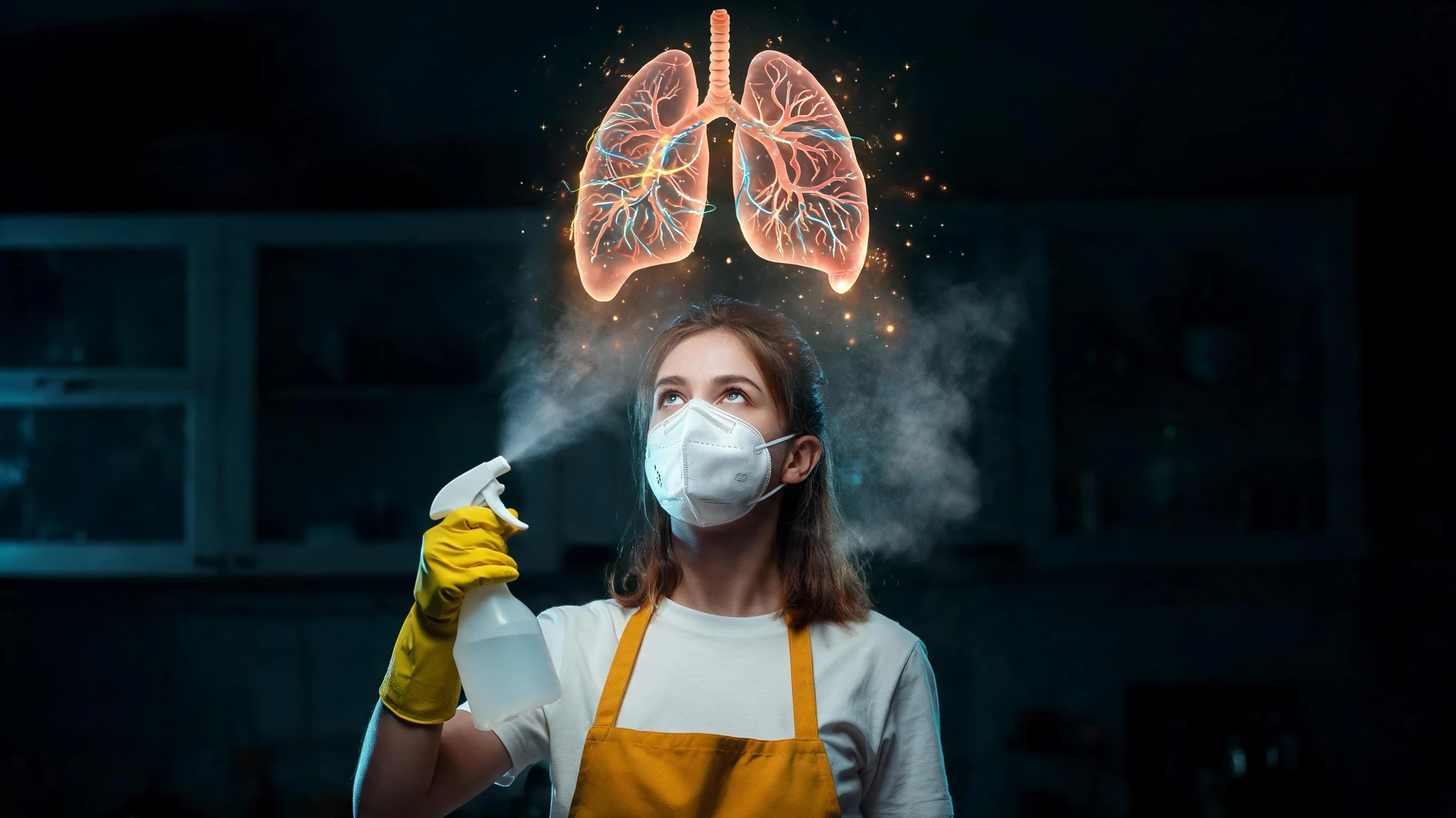
Women who cleaned regularly at home or as part of their job lost lung function over 20 years at a rate the researchers compared to smoking 10 to 20 cigarettes a day during the same period, according to a study of 6,235 adults from across Europe published in the American Journal of Respiratory and Critical Care Medicine in 2018.1 The work, led by Øistein Svanes and colleagues at the University of Bergen, drew on the long-running European Community Respiratory Health Survey and looked specifically at how regular contact with cleaning agents tracked with the slow narrowing of the airways that doctors measure with a spirometer.
The headline number is striking, and it has been repeated widely. The detail underneath it is more useful. The decline showed up in women, not in men in the same study. It was strongest in those who cleaned occupationally, but it was also visible in women who only cleaned their own homes. And it appeared on a specific lung-function curve called FEV1, the volume of air a person can blow out hard in the first second of an exhale.1
What the 20-year study actually measured
The Bergen team followed participants who had originally been enrolled in the European Community Respiratory Health Survey, a multi-country cohort that started in the early 1990s. Each person did a spirometry test at baseline, then again roughly a decade later, then again about a decade after that. They also answered detailed questionnaires about their work, their home cleaning habits, and which products they used.1
By comparing the slope of each person’s FEV1 over those two decades against their cleaning exposure, Svanes and colleagues could ask a fairly clean question. Did the airways of people who cleaned a lot narrow faster than the airways of people who did not? In women, yes. The accelerated drop in FEV1 in the cleaning group was on the order of 3.6 milliliters per year extra in occasional home cleaners and around 3.9 milliliters per year extra in occupational cleaners, compared with women who did not report regular cleaning.1 Numbers that small per year add up across two decades, and the authors put the cumulative loss in the same range as moderate long-term smoking.
It is worth being precise about that comparison. Svanes and colleagues did not claim that one bottle of bathroom spray equals one cigarette. They were saying that the slope of decline they observed in regular female cleaners was within the same order of magnitude as what the literature on smoking shows for someone who smokes 10 to 20 cigarettes a day for 10 to 20 years. The biology behind those two declines is not the same. The endpoint, on a spirometry chart, looked similar.
Why would cleaning sprays do this?
Most household cleaners are designed to do a job at a surface, not in your lungs. The trouble is the route from the bottle to the surface. A spray nozzle aerosolizes the liquid into a fine cloud, and a fraction of that cloud drifts upward into the breathing zone of the person holding the trigger. Quaternary ammonium compounds, sodium hypochlorite (the active ingredient in chlorine bleach), peroxides, alcohols, and a long list of fragrance chemicals all turn up in those droplets.3
Inhaled often enough, these substances irritate the lining of the airway. Repeated low-grade irritation is not the same as an allergic reaction, although it can sit on top of one. Over years, it can drive a chronic inflammatory state in the bronchial walls, and chronic inflammation is one of the recognized routes to fixed, irreversible airway narrowing of the kind seen in chronic obstructive pulmonary disease.5

Disinfectants used in healthcare have given researchers a clearer view of the same mechanism. A 2019 analysis published in JAMA Network Open followed roughly 73,000 female nurses in the United States and tracked their use of bleach, hydrogen peroxide, alcohol, glutaraldehyde, and quaternary ammonium compounds. Nurses who used those disinfectants weekly to clean surfaces had a 22 to 32 percent higher rate of incident COPD over an eight-year follow-up than nurses who did not, even after accounting for age, smoking history, and body mass index.5 The same group’s earlier work had shown that weekly use of those products was almost universal in U.S. hospitals, and that bleach and quats were the most frequent.4
Cleaners who already have asthma show short-term effects too. A 2015 study by Vizcaya and colleagues asked female cleaners with diagnosed asthma to track their symptoms across a working week and matched the diary entries against which products they used that day. Use of bleach, ammonia, and multipurpose sprays was associated with measurable next-day declines in peak expiratory flow and an increase in cough and wheeze.3 The effect was acute and reversible in those women, which is a different finding from the long-term, partially fixed loss reported by Svanes. Both pieces of evidence point in the same direction.
Why women, and why didn’t men show it?
This is the question the original paper raises and only partly answers. Across the European cohort, men reported far less regular cleaning, and when they did clean, they tended to use different products and different methods. With fewer exposed men in the dataset, the statistical power to detect a small change in their FEV1 trajectory was lower. The authors explicitly say that they cannot rule out a similar mechanism in men; they can only say that, in this dataset, the decline reached significance in women.1
There may also be biological reasons. Women’s airways are smaller in absolute terms than men’s, and a smaller airway is more sensitive to a given dose of inhaled irritant. The research community treats this as a plausible contributor rather than a settled fact. What is settled is that female-dominated occupational cleaning is one of the highest-risk routes of exposure on record, with multiple cohorts showing elevated rates of asthma, rhinitis, and lower respiratory symptoms in commercial cleaners and nurses.2

What this is not
It is not a randomized trial. The Svanes paper is observational, which means it can show a strong association between regular cleaning and accelerated FEV1 decline but cannot, on its own, prove that the cleaning agents caused the decline. People who clean a lot may differ from people who do not in ways the questionnaires didn’t capture, and some of those unmeasured differences could in principle drive part of the result. The authors did adjust for smoking, age, height, baseline asthma, and several other plausible confounders, and the cleaning-related decline survived the adjustment.1 That makes pure confounding less likely as the full explanation, without ruling it out.
It is also not a verdict on cleanliness. Sanitation matters, especially in healthcare settings, and giving up on cleaning your home is not on the menu. The reasonable read on this body of work is that the way you clean and the products you use change the inhaled dose of reactive chemicals you absorb each year, and that dose seems to matter for long-term respiratory health.5
What actually lowers your inhaled dose
Most of the practical advice falls out of the chemistry. The goal is to keep aerosols and fumes out of the breathing zone, and to swap reactive products for milder ones when the job allows it.
Open a window. The single most reproducible finding in indoor-air studies is that cross-ventilation, even from one cracked window and one open door, drops the airborne concentration of volatile cleaning agents within minutes. A box fan pointed at the open window helps further. If a bathroom has no window, run the exhaust fan throughout cleaning and for at least 15 minutes after.
Switch a spray for a wipe where you can. Pouring or squeezing a liquid onto a cloth and wiping the surface delivers almost no aerosol into the air. The same cleaner used as a trigger spray throws fine droplets several feet beyond the surface, and many of those droplets stay airborne for minutes. This is exactly the kind of low-friction swap that occupational hygienists have recommended in nursing settings for years.4

Use the gentlest product that works. White vinegar (acetic acid) and dish soap dissolved in warm water handle a surprising share of routine domestic cleaning. Microfiber cloths, alone or with plain water, lift dust and surface grime mechanically. Reserve bleach, quaternary ammonium products, and concentrated bathroom cleaners for the jobs they actually need to do, like a real disinfection event after illness or visible mildew, not for routine wipe-downs.
Never mix products. Bleach plus ammonia (which is in many glass cleaners) releases chloramine gas. Bleach plus an acid cleaner (some toilet bowl products) releases chlorine gas. Both are acutely toxic to airway tissue, and both can cause permanent damage from a single sharp exposure. The simplest safe rule is to fully rinse a surface with water before applying a different product to it.
Wear a well-fitted N95 or half-face respirator for the heavy jobs. Oven cleaner, drain unblockers, mold removers, and grout strippers are not routine wipe-downs. They are short, intense exposures, and a proper mask plus an open window cuts the inhaled dose dramatically.
Common questions about cleaning chemicals and lung function
Are “natural” or “green” cleaners safe for the lungs?
Mostly yes for the dose your lungs see in routine use, but not always. Some plant-derived fragrance compounds (limonene, pinene) can react with ozone in indoor air to form ultrafine particles that are themselves irritating. The label “natural” is not a guarantee of inhalation safety. Ventilation still matters.
Does this study mean I will get COPD if I clean my own house?
No. The 20-year decline reported by Svanes and colleagues was an average across a large cohort, and individual risk depends heavily on smoking, baseline lung health, family history, and how concentrated and frequent the exposures are.1 Most people who clean their own home occasionally with mild products are at low individual risk. The signal is real for heavy, daily, spray-based exposure over decades.
Are professional cleaners and nurses at higher risk than home cleaners?
The data say yes. Multiple studies of cleaners and healthcare workers show elevated rates of asthma, chronic bronchitis, and accelerated FEV1 decline compared with the general working population.2,5 The reason is dose. The exposure is more concentrated, more frequent, and lasts the whole working day.
Does the damage reverse if I stop using harsh sprays?
Some of it. Acute irritation, cough, and short-term peak-flow drops typically resolve within days to weeks of removing the exposure.3 The component of the long-term FEV1 loss that comes from fixed airway remodeling is, by definition, not reversible. That is why the prevention angle (lower the dose now) is the practical takeaway, not the rescue angle.
Should I throw out my cleaning products tomorrow?
You don’t need to. A more useful first move is to ventilate while cleaning, swap your most aggressive sprays for wipe-on application, and reserve the heavy products for the jobs they were designed for.

Where this leaves you
The Svanes paper is one piece of evidence, not the last word, and the cigarettes-per-day framing is a comparison of decline curves rather than a one-to-one biological equivalence. Even with those caveats, the broader literature on cleaners, nurses, and disinfectants is consistent enough that respiratory researchers no longer treat the link as speculative. Long-term inhalation of reactive cleaning chemicals appears to leave a measurable mark on lung function.1,5
The encouraging part is that the dose is the lever. You decide how often you reach for the trigger spray, whether the window is open, whether you wear gloves and a mask for the harder jobs, and which products live under your sink in the first place. None of those changes cost much, and they don’t make your house dirtier. They just keep more of the chemistry on the surface, where it belongs, and out of the air you breathe while you work.
If you already have asthma, COPD, or another chronic respiratory condition, talk to your doctor or a respiratory therapist about which products to avoid entirely. They can also point you toward an occupational hygienist if your job involves heavy daily cleaning, since workplace exposure limits and proper respirator fitting are usually outside what a home routine can solve.
Sources
- Svanes Ø et al. Cleaning at Home and at Work in Relation to Lung Function Decline and Airway Obstruction. American Journal of Respiratory and Critical Care Medicine, 2018. PubMed: 29451393
- Mirabelli MC et al. Occupational risk factors for asthma among nurses and related healthcare professionals in an international study. Occupational and Environmental Medicine, 2007. PubMed: 17332135
- Vizcaya D et al. Cleaning products and short-term respiratory effects among female cleaners with asthma. Occupational and Environmental Medicine, 2015. PubMed: 25907212
- Dumas O et al. Determinants of disinfectant use among nurses in U.S. healthcare facilities. American Journal of Industrial Medicine, 2017. PubMed: 27862135
- Dumas O et al. Association of Occupational Exposure to Disinfectants With Incidence of Chronic Obstructive Pulmonary Disease Among US Female Nurses. JAMA Network Open, 2019. PubMed: 31626315