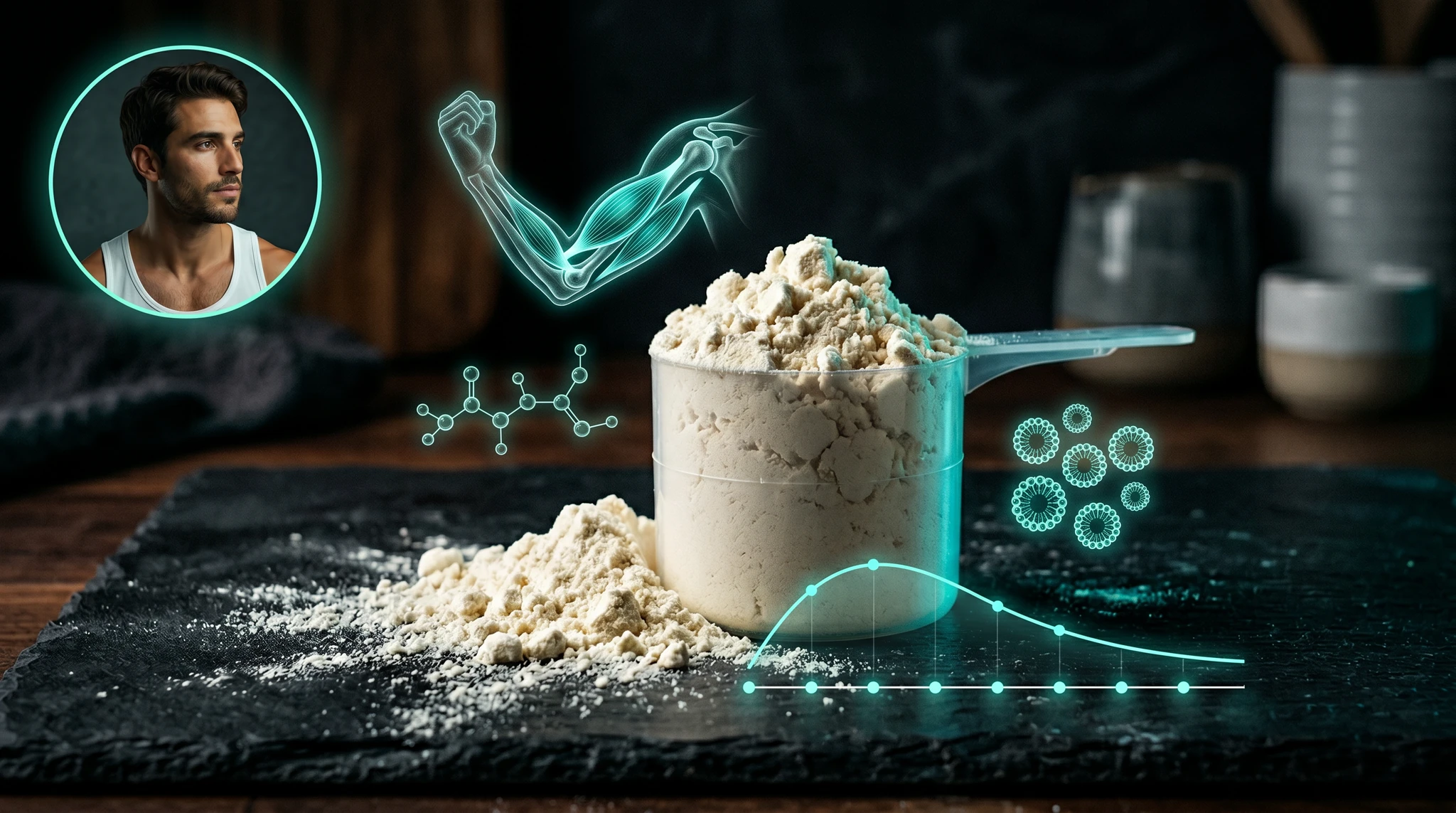
A 2012 trial out of Maastricht University found that healthy young men who drank 40 grams of casein protein 30 minutes before bed raised their overnight muscle protein synthesis rates by about 22 percent compared with a placebo. The men had finished an evening resistance workout, then climbed into bed in a metabolic ward where researchers tracked amino acid uptake hour by hour. The lead author was Peter Res, and the work appeared in Medicine & Science in Sports & Exercise.1
That single result, modest in scale and very specific in design, has since fueled a decade of follow-up trials, a few overstated headlines, and a quiet shift in how some athletes think about the last meal of the day. The story is more interesting than the headline, and the caveats matter more than the percentage.
What did the original study actually do?
The Res trial enrolled 16 healthy young men, average age around 24, all of them already training. After a standardized dinner they performed an evening resistance workout, two leg exercises, multiple sets to failure. Thirty minutes before lights out they drank either 40 grams of casein dissolved in water, or a flavor-matched placebo. Both drinks were spiked with stable-isotope-labeled amino acids so the team could trace exactly where the protein went once digestion finished.
Across the night, the casein group held a positive whole-body protein balance. The placebo group did not. Mixed muscle protein synthesis ran 22 percent higher in the casein group over a roughly seven-and-a-half-hour overnight window.1 The labeled amino acids showed up in actual muscle tissue, not just in blood. That last detail is what made the paper a citation magnet. Earlier studies had measured blood amino acids and inferred the rest. Res and colleagues measured muscle.
Why casein, and not whey?
Casein and whey both come from cow’s milk, but they behave very differently in the gut. Whey clears fast. You drink it, blood amino acids spike within an hour, and they fall back to baseline within two or three. Casein curdles in stomach acid and forms a soft clot that the small intestine has to dismantle slowly. Amino acids dribble out for six to eight hours, sometimes longer.2
Yves Boirie’s 1997 paper in PNAS was the one that nailed this distinction. Boirie’s group fed volunteers either whey or casein and measured leucine kinetics through the afternoon. Whey produced what the authors called a “fast” protein response, big spike, fast oxidation, less net retention. Casein produced a “slow” response, lower peak, longer plateau, more amino acid retention overall.2 They coined the slow-versus-fast terminology that the field still uses.
For the seven or eight hours you spend asleep, slow wins. Whey before bed empties out by midnight. Casein keeps feeding the system until breakfast. That is the entire physiological case for the 30-minutes-before-sleep timing.

Does it actually build more muscle over time?
One night of higher synthesis rates is interesting. Twelve weeks of training is the test that matters. Tim Snijders and the Maastricht group ran exactly that study in 2015. Forty-four young men trained three times a week for 12 weeks. Half drank a presleep beverage with 27.5 grams of casein and 15 grams of carbohydrate. The other half drank a placebo. Both groups gained strength and muscle. The casein group gained more.3
Quadriceps cross-sectional area grew about 8.4 cm² in the casein group versus 4.8 cm² in the placebo group. One-rep max on the leg press went up by an average of 165 kg in casein, 130 kg in placebo. Type II fiber size, the fast-twitch fibers most responsive to heavy lifting, grew significantly more with the presleep dose. The size of those gains in absolute terms is small, but the gap between groups was real.3
A few caveats sit on top of that result. Total daily protein in the casein arm averaged roughly 1.9 grams per kilogram of body weight. The placebo arm averaged about 1.3. So the casein group also ate more protein overall, not just more protein at night. Snijders himself, in a 2019 update review, was careful to flag this.4 The presleep dose may simply be a convenient delivery vehicle for hitting a higher daily total, and the daily total may be doing most of the work.
What about people who do not lift weights?
Most of the presleep-casein literature studies trained young men. The signal in untrained people, in older adults, and in women is thinner. A 2021 trial by Andrew Holwerda’s group looked at older men, average age 71, doing evening resistance exercise. Forty grams of casein before sleep raised overnight muscle connective tissue protein synthesis, but the effect on myofibrillar synthesis specifically was less clear-cut than in young men.5 Older muscle is more anabolically resistant. It needs more protein per dose to hit the same response. The 40-gram bedtime feed may help bridge that gap, but it is not a fix on its own.
Women have been studied less. The handful of trials that included female participants suggest the digestion pattern of casein is similar, but published outcomes for muscle mass and strength in women specifically are limited. Anyone extrapolating the Res or Snijders results onto a 55-year-old woman who walks for exercise is going beyond what the data say.4

Is 40 grams the magic number?
Probably not, and the field has been inching away from that figure. The 40-gram dose in the Res study was chosen because earlier work suggested smaller doses, around 20 grams, produced a modest but blunted overnight response. Trommelen and colleagues later showed that the labeled amino acids from a presleep casein meal really do end up in myofibrillar protein, the contractile machinery itself, but the dose-response curve is not flat.7
The current International Society of Sports Nutrition position stand recommends a per-meal protein dose of roughly 0.4 to 0.55 grams per kilogram of body weight to maximize muscle protein synthesis, which lands between 28 and 45 grams for most adults.6 A presleep feeding sitting at the upper end of that window, 30 to 40 grams of a slow protein, is consistent with the trial data and with the broader sports nutrition literature.
Going higher rarely hurts in healthy people, but the returns flatten quickly. There is no published evidence that 60 or 80 grams of casein before bed produces meaningfully more overnight synthesis than 40.
Does eating at night ruin sleep, fasting, or breakfast?
This is where popular advice gets tangled. Three concerns come up most often.
The first is sleep. A liquid casein dose around 30 grams does not appear to disturb sleep architecture in the trials that have measured it, though those trials are short and the participants are usually athletic young men with healthy sleep to begin with. Heavy mixed meals close to bed are a different story; that is not what the protein-before-sleep research is testing.
The second is intermittent fasting. If your eating window closes at 8 p.m., a 10 p.m. casein drink breaks the fast. Whether that matters depends on why you are fasting. For weight management it adds about 130 to 160 calories. For metabolic markers like fasting glucose, the morning numbers are unlikely to shift meaningfully from 30 grams of casein the night before, but the literature is thin enough that anyone managing a metabolic condition should ask their clinician.
The third is whether eating overnight blunts the morning meal’s anabolic response. Benjamin Wall’s group answered this in 2016. Forty grams of casein before sleep did not reduce the muscle protein synthetic response to a protein-rich breakfast the next morning.8 The two doses appear to be additive rather than competitive.
What food actually delivers casein?
Casein is the dominant protein in most dairy. About 80 percent of the protein in cow’s milk is casein, the rest is whey. So a glass of milk before bed delivers some casein, but the dose is small. A cup of whole milk has about 8 grams of total protein. To hit a presleep dose in that 30 to 40 gram range from milk alone, you would need roughly four cups, which most people would not finish or sleep through.
Cottage cheese is denser. A standard cup of low-fat cottage cheese contains around 24 to 28 grams of protein, most of it casein. A bowl of plain Greek yogurt sits around 17 to 23 grams per cup. Skyr is similar. Hard cheeses are protein-dense but also fat- and salt-dense, which makes them a less practical bedtime food in larger amounts.
Casein protein powder remains the cleanest delivery vehicle if you want a precise dose without the sugar, fat, or volume. Mixed in water it tastes thick. Mixed in milk it gets thicker. The original Res protocol used straight powder in water 30 minutes before sleep. A real cottage cheese bowl with some berries is less clinical and likely close enough for most people.
Where the evidence stands in 2026
Snijders’ 2019 update review remains the most balanced public summary of the field. His conclusion, paraphrased honestly, was that presleep protein ingestion is an effective strategy to increase overnight muscle protein synthesis and may support gains during prolonged resistance training, particularly when total daily protein intake would otherwise be inadequate.4 The hedge is doing real work in that sentence. If your daily protein is already at 1.6 to 2.0 grams per kilogram and well distributed, the presleep dose adds something measurable but small. If your daily protein is low and clustered into one or two meals, a 30-gram casein feed before bed is probably the highest-leverage tweak you can make.
Headlines that promise a 22 percent muscle boost from a bedtime shake are technically accurate to the original measurement and badly misleading about what it means in practice. A 22 percent jump in an overnight synthesis rate is not the same as 22 percent more muscle on your frame in three months. Most controlled trials in trained adults find single-digit-percent gains in muscle cross-section over 10 to 12 weeks, and the presleep contribution to those gains is part of a much bigger nutritional and training picture.34
Common questions about casein protein before bed
Does casein before bed cause weight gain?
A 30 to 40 gram casein dose adds roughly 120 to 160 calories. In an overall calorie-controlled diet, those calories displace other intake rather than stack on top. Trials of presleep protein in healthy adults have not consistently shown weight gain beyond what would be expected from total intake.
Is cottage cheese as good as a casein shake?
For most people, yes. A cup of cottage cheese delivers a casein-rich dose in a real-food matrix with some calcium and probiotics depending on the brand. Powder is more precise but not categorically better.
Does it work without exercise that day?
The biggest synthesis gains in the trials happened in people who had trained earlier in the evening. Without the training stimulus, presleep protein still provides amino acids overnight, but the magnitude of muscle-building benefit is smaller.
What about plant-based casein alternatives?
Soy and pea blends digest slower than whey but faster than casein. A 2020 trial comparing presleep whey to a plant blend after damaging morning exercise found similar recovery markers in both, though the long-term picture for plant proteins at bedtime is still being written.
Can older adults benefit too?
Some evidence says yes, particularly for connective tissue synthesis, but older muscle responds less efficiently and may need higher per-meal doses to see clear effects.5
How to think about it without overdoing it
The honest version goes something like this. If you train hard in the evening and your protein for the day has been thin, eating around 30 grams of casein 30 minutes before bed is supported by the cleanest mechanistic evidence in sports nutrition. It is not a hack. It is one well-timed meal among the four or five your muscles want during a training day. The studies that have followed people for months show real but modest payoffs, and those payoffs come paired with consistent training and consistent total protein.
If you do not lift, do not lift in the evening, or already eat plenty of protein at dinner, the bedtime dose is unlikely to be the move that changes your body. A bowl of cottage cheese is a good snack regardless. Calling it the secret to overnight muscle growth is the kind of overstatement that makes legitimate sports nutrition harder to trust.
Sources
- Res PT, Groen B, Pennings B, et al. Protein ingestion before sleep improves postexercise overnight recovery. Med Sci Sports Exerc. 2012. PubMed: 22330017
- Boirie Y, Dangin M, Gachon P, et al. Slow and fast dietary proteins differently modulate postprandial protein accretion. Proc Natl Acad Sci U S A. 1997. PubMed: 9405716
- Snijders T, Res PT, Smeets JS, et al. Protein Ingestion before Sleep Increases Muscle Mass and Strength Gains during Prolonged Resistance-Type Exercise Training in Healthy Young Men. J Nutr. 2015. PubMed: 25926415
- Snijders T, Trommelen J, Kouw IWK, et al. The Impact of Pre-sleep Protein Ingestion on the Skeletal Muscle Adaptive Response to Exercise in Humans: An Update. Front Nutr. 2019. PubMed: 30895177
- Holwerda AM, Lenaerts K, Bierau J, et al. Exercise Plus Presleep Protein Ingestion Increases Overnight Muscle Connective Tissue Protein Synthesis Rates in Healthy Older Men. Int J Sport Nutr Exerc Metab. 2021. PubMed: 33588378
- Jäger R, Kerksick CM, Campbell BI, et al. International Society of Sports Nutrition Position Stand: protein and exercise. J Int Soc Sports Nutr. 2017. PubMed: 28642676
- Trommelen J, Kouw IWK, Holwerda AM, et al. Presleep dietary protein-derived amino acids are incorporated in myofibrillar protein during postexercise overnight recovery. Am J Physiol Endocrinol Metab. 2018. PubMed: 28536184
- Wall BT, Burd NA, Franssen R, et al. Presleep protein ingestion does not compromise the muscle protein synthetic response to protein ingested the following morning. Am J Physiol Endocrinol Metab. 2016. PubMed: 27780822