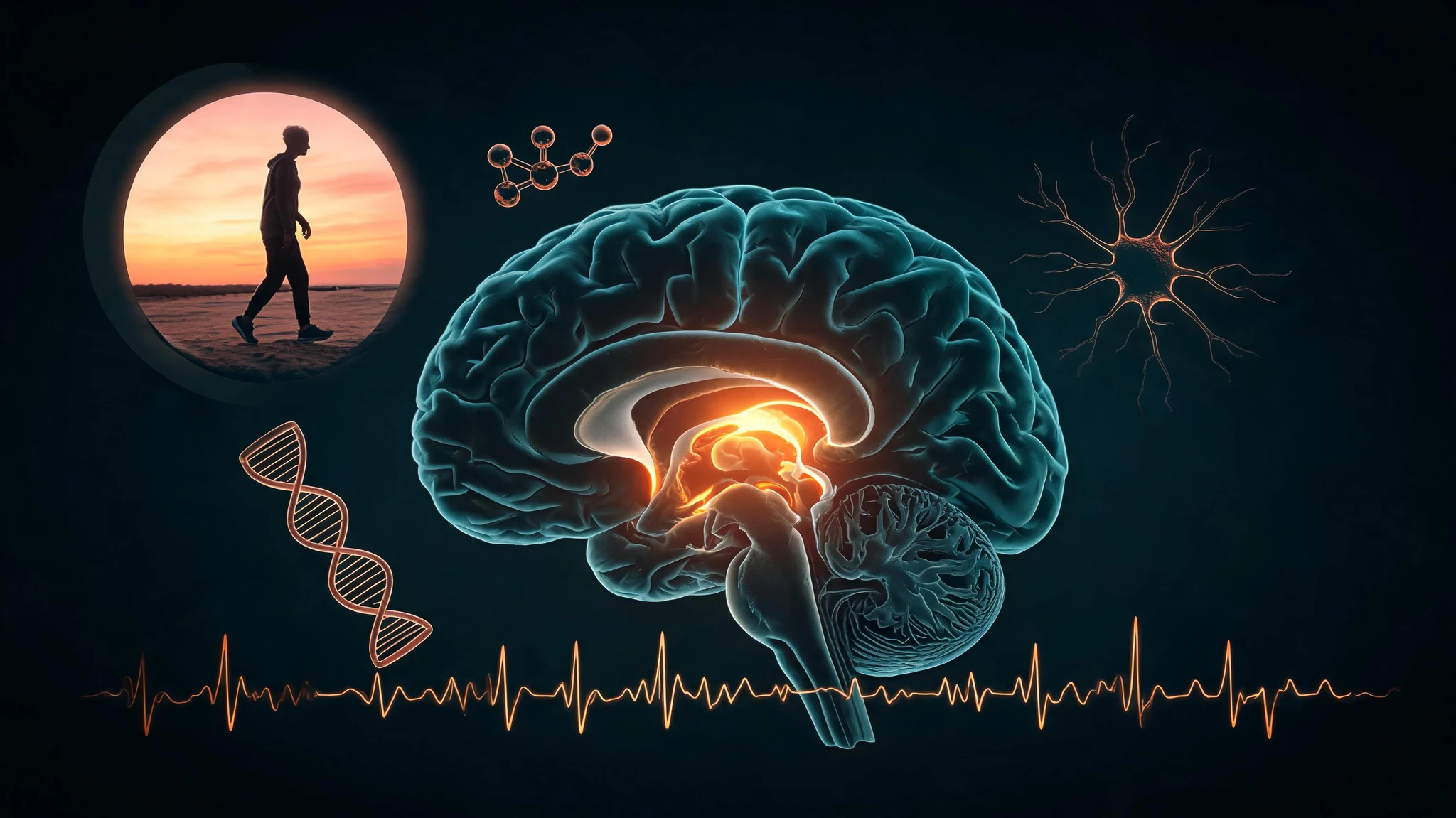
One year of brisk walking, three days a week, was enough to grow the memory center of the brain in older adults who had been losing it. That is the unusually clean result reported by Kirk Erickson and colleagues in the Proceedings of the National Academy of Sciences in 2011, and it has held up against more than a decade of follow-on work.1
The trial randomized 120 sedentary adults in their mid-60s to either a walking program or a stretching and toning program. After 12 months, the walkers’ hippocampus, the seahorse-shaped structure tucked deep in each temporal lobe, was about 2% larger on MRI. The stretching group’s hippocampus shrank by roughly 1.4%, which is what aging brains usually do.1 The researchers framed that gap as the equivalent of reversing one to two years of age-related decline.
What the walkers actually did
The protocol was not heroic. Participants started with 10-minute walks and worked up to 40 minutes per session, three sessions per week, at a target heart rate of 50 to 60% of their maximum at first and 60 to 75% by week seven. They walked outdoors when the Pittsburgh weather allowed and on a track indoors when it did not. They wore heart-rate monitors. They had a leader. They had each other. That last part matters more than people think.
The control group did supervised stretching, balance, and toning for the same number of sessions. They were not sitting on the couch. The contrast in the trial is not movement versus stillness. It is aerobic movement that nudges the heart rate up versus gentle movement that does not.1 The hippocampus appears to care about the difference.
Why the hippocampus, and why does it matter
The hippocampus is the brain region you would miss most. It binds new experiences into memories, anchors you in space, and lets you remember where you parked. It is one of the first areas hit in Alzheimer’s disease and one of the few places in the adult human brain where new neurons are still being born throughout life. It is also unusually responsive to lifestyle. Cardiorespiratory fitness in older adults tracks closely with hippocampal volume on MRI, even outside of any intervention.2

That earlier observational work, also led by Erickson, scanned 165 nondemented older adults and found that fitter participants had bigger hippocampi, and bigger hippocampi predicted better spatial memory.2 The 2011 trial was the natural next step: take sedentary people, get them moving, and see whether the structure changed. It did.
It is not just one study
One trial is a starting point, not a verdict. Two large prospective cohorts give the finding a wider footing. In the Nurses’ Health Study, women who walked at least 1.5 hours a week at an easy pace scored higher on cognitive tests and showed slower cognitive decline than less active peers, with the benefit climbing as walking volume rose.3 The Honolulu-Asia Aging Study followed 2,257 physically capable older men for several years and found that those who walked less than a quarter mile a day had nearly twice the dementia risk of men who walked more than two miles.4
A 2022 systematic review and meta-analysis pooled randomized trials of aerobic exercise in older adults and found a small but reliable improvement in episodic memory, the kind of memory the hippocampus does most of the work for.6 The effect was modest. It was also consistent across studies, which is rarer than it sounds in this corner of the literature.
What is BDNF, and is it really brain fertilizer?
The shorthand the source post uses, “fertilizer for your brain,” comes from a real molecule with a real job. Brain-derived neurotrophic factor, or BDNF, is a small protein that helps neurons survive, encourages the growth of new connections between them, and supports the birth of new cells in the hippocampus.5 Animals that exercise produce more of it. Their hippocampal cells survive longer, branch more, and learn faster.

The Erickson trial measured serum BDNF in participants and found that walkers’ BDNF levels rose, and that the rise tracked, modestly, with the change in hippocampal volume.1 Serum BDNF is an imperfect proxy for what is happening inside the skull, since most circulating BDNF comes from platelets rather than neurons. The mechanistic story is plausible and partially supported, not nailed shut. The classic Cotman and Berchtold review in Trends in Neurosciences laid out why exercise is one of the few non-pharmacological interventions that reliably nudges this system in the right direction.5
How big is “2%,” really?
A 2% volume increase sounds small. In the context of an older adult’s brain, where annual shrinkage of 1 to 2% in the hippocampus is roughly normal after 60, it is actually large. The walkers were not just slowing the decline. They were running it backwards for a year.1
That said, the 2% number is a group average. Some walkers gained more, some less, and a few barely moved. Bigger gains showed up in people whose fitness improved the most over the year, which lines up with broader cross-sectional data showing that physical activity and gray-matter volume travel together across multiple brain regions.7 The take-home is not “walk for a year and your hippocampus will be exactly 2% bigger.” It is that consistent aerobic movement, in this dose, can shift brain structure in older adults in a measurable, useful direction.
Could this be placebo, or just better blood flow?
Both questions are fair. The control group did get a real intervention, supervised group sessions on the same schedule, so social contact and expectations were roughly matched. They still shrank.1 That argues against a pure placebo or social-contact explanation.
Better blood flow is almost certainly part of the story, but probably not all of it. Aerobic exercise improves cerebrovascular health, increases capillary density, and reduces the kind of small-vessel disease that quietly chews away at the aging brain. Underneath that, animal work points to neurogenesis, synapse formation, and reduced inflammation. In humans, the methods cannot tease these apart cleanly. The honest summary is that several biological pathways probably contribute, all of them respond to the same input, and the input is leg movement that elevates the heart rate.5
What does this look like in a normal week?
The trial dose was 40 minutes, three times per week, brisk enough to feel like work. That is 120 minutes of moderate aerobic activity, which slots neatly into the WHO and US guidelines of at least 150 minutes per week for adults. Most people do not need to invent a program. They need to walk faster, longer, and more often than they currently do.

“Brisk” is the operative word. A useful rule: you should be able to talk in short sentences but not sing. A heart-rate monitor on your wrist is helpful but optional. The trial nudged people from a slow stroll, where benefits to brain volume are modest, into a pace that meaningfully raises heart rate, which is where the dose seems to bite.1
Consistency beat intensity in this study. Three times a week, every week, for a year. People who only walked when the weather was good probably did not see the same effects, though the trial did not formally test that. The boring answer is that brain change in this dose appears to be a function of accumulated weeks, not heroic single sessions.
One practical wrinkle: the gains were dose-responsive. Walkers whose cardiorespiratory fitness improved most over the year tended to be the ones whose hippocampi grew most.1 So if your walks are getting easier and your resting heart rate is drifting down, that is the signal you want. If month six feels exactly like month one, the pace probably has to come up a notch. A simple rule of thumb is to add five minutes to one weekly session every two weeks until you are at the 40-minute mark, then begin nudging the pace.
Who, realistically, was studied?
The 2011 trial enrolled people aged 55 to 80, mostly white, mostly female, all sedentary at baseline, all without dementia at entry.1 That is a real limitation. Whether the same dose produces the same hippocampal growth in a 40-year-old, in someone with mild cognitive impairment, or in groups underrepresented in the original cohort is an open question. The cohort studies fill in some of the picture, since they include thousands of women and men across more diverse backgrounds, and the direction of effect is the same.3,4
Younger adults probably benefit too, since fitness and gray matter track together across the lifespan, but the brain growth signal is hardest to detect in groups whose hippocampus is not yet shrinking.7 If you are in your 30s or 40s, the framing flips: you are not reversing decline, you are buying yourself a thicker margin before decline starts.
Common questions about walking and brain health
Do I need to walk for a full year before anything happens?
No. Cognitive scores in shorter aerobic-exercise trials often improve in three to six months. The hippocampal-volume change in the Erickson trial was measured at 6 and 12 months, and most of the gain came over the second half of the year. Earlier benefits are often functional (memory, attention) before they are structural.6
Does running or cycling work as well as walking?
Probably yes, and possibly better. The trial used walking because it is accessible to sedentary older adults. The active ingredient is sustained moderate-to-vigorous aerobic effort. Cycling, swimming, dancing, and rowing should hit the same target if the heart rate and duration are similar.
Will strength training do the same thing?
Resistance training has its own brain benefits, particularly for executive function, but the specific hippocampal-growth signal is strongest for aerobic work. The cleanest plan is to do both, and not to let strength sessions crowd out the cardio minutes.6
What if I already have memory problems?
Talk to a clinician before starting, especially if you have heart or joint issues. Several trials in mild cognitive impairment have shown smaller but real cognitive gains from aerobic programs. It is not a cure for dementia, and no honest researcher claims it is.
Is walking outdoors better than walking on a treadmill?
For brain volume, the trial did not separate the two. Outdoor walking adds sunlight, social contact, and varied terrain, all of which probably help in their own right. If a treadmill is what gets you to do the work in February, that is the right answer.
The honest bottom line
The 2011 trial did not prove that walking cures aging or prevents dementia. It showed something narrower and more useful: in 120 sedentary older adults, a year of brisk walking three times a week was associated with a measurable increase in hippocampal volume, a measurable improvement in spatial memory, and a measurable rise in BDNF, while a matched control group shrank as predicted.1 Larger cohort studies and a 2022 meta-analysis make the broader claim, that consistent aerobic activity supports cognitive aging, harder to dismiss.3,4,6
The intervention is free, available, and unfashionable. That last part is a feature. It will not be patented, it will not be marketed, and it does not need to be. Walking is one of the few things in the wellness conversation that is supported by both common sense and good data, and the dose is small enough that almost any adult can attempt it. The brain seems to repay the favor.
If you are looking for a single number to act on, the trial’s number is 120 minutes a week of brisk walking, split into three sessions, kept up for a year. That is the protocol that produced the result. Anything less may still help. Almost certainly nothing else this simple will help more.
Sources
- Erickson KI, Voss MW, Prakash RS, et al. Exercise training increases size of hippocampus and improves memory. Proc Natl Acad Sci U S A. 2011;108(7):3017–3022. PubMed: 21282661
- Erickson KI, Prakash RS, Voss MW, et al. Aerobic fitness is associated with hippocampal volume in elderly humans. Hippocampus. 2009;19(10):1030–1039. PubMed: 19123237
- Weuve J, Kang JH, Manson JE, et al. Physical activity, including walking, and cognitive function in older women. JAMA. 2004;292(12):1454–1461. PubMed: 15383516
- Abbott RD, White LR, Ross GW, et al. Walking and dementia in physically capable elderly men. JAMA. 2004;292(12):1447–1453. PubMed: 15383515
- Cotman CW, Berchtold NC. Exercise: a behavioral intervention to enhance brain health and plasticity. Trends Neurosci. 2002;25(6):295–301. PubMed: 12086747
- Aghjayan SL, Bournias T, Kang C, et al. Aerobic exercise improves episodic memory in late adulthood: a systematic review and meta-analysis. Commun Med (Lond). 2022;2:15. PubMed: 35603310
- Erickson KI, Leckie RL, Weinstein AM. Physical activity, fitness, and gray matter volume. Neurobiol Aging. 2014;35 Suppl 2:S20–S28. PubMed: 24952993