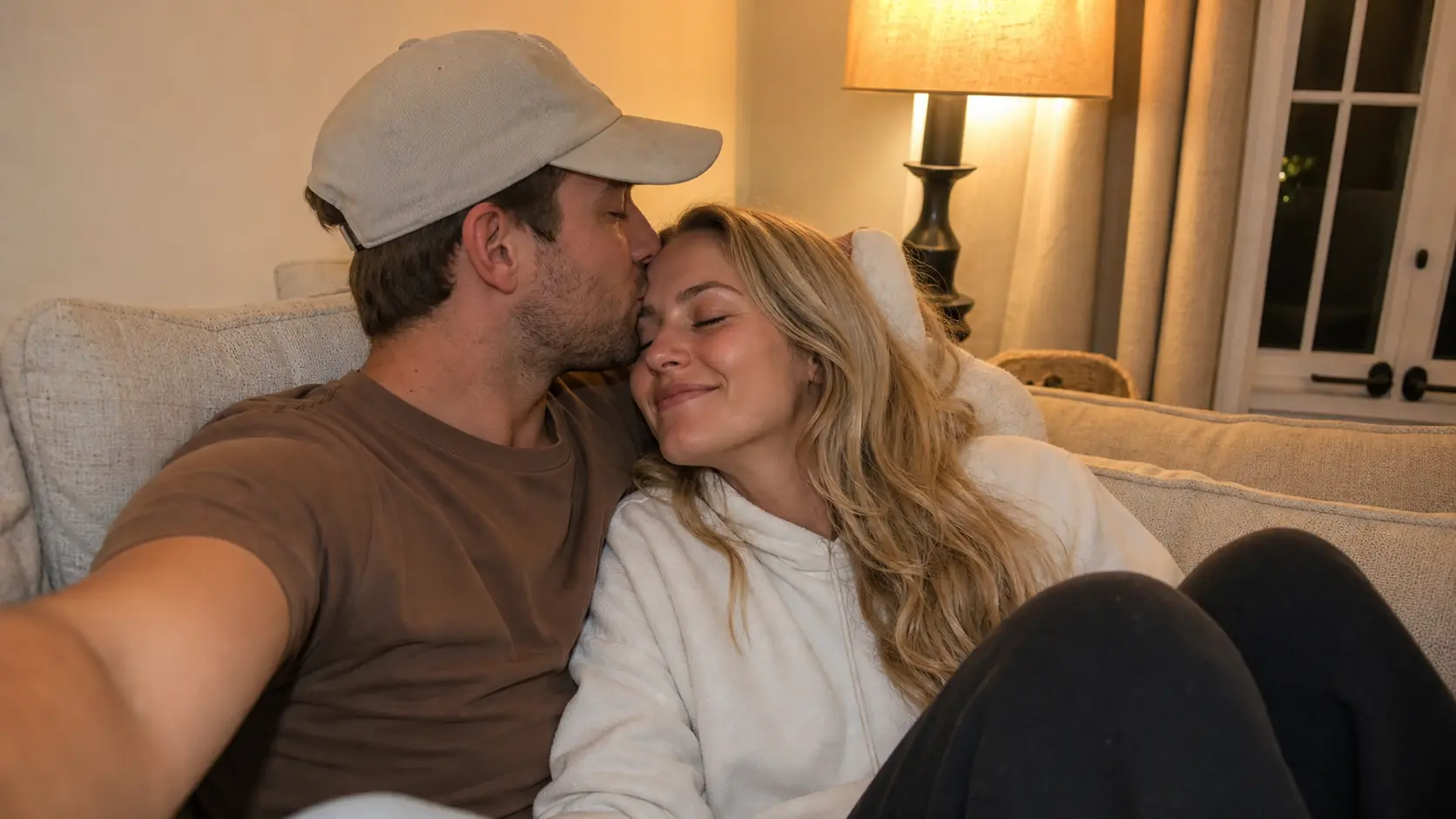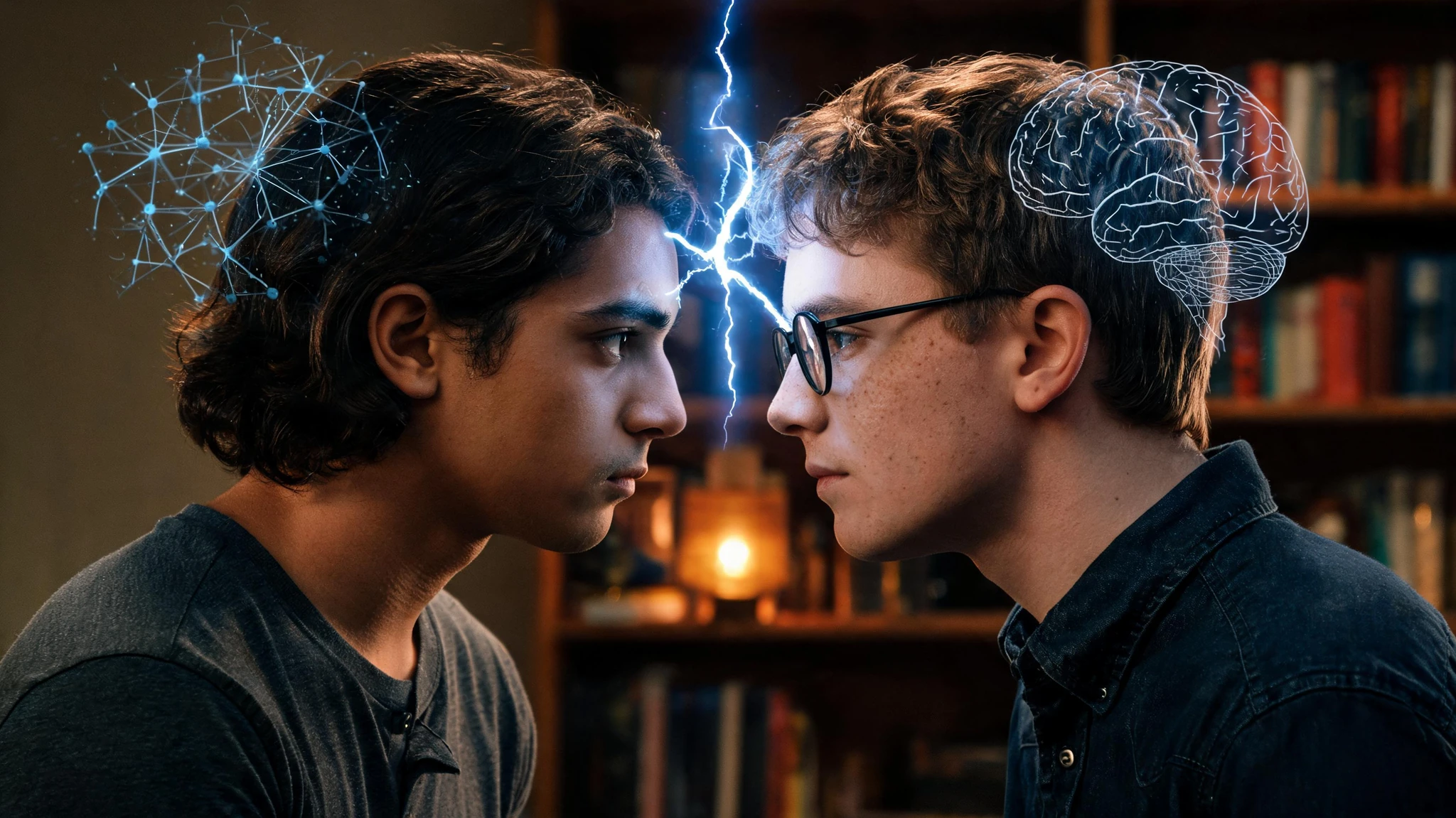
Two people sitting across from each other can, under the right conditions, show brain activity that lines up in time. The effect is called neural synchrony, and it has been recorded in real lab experiments using two brain scanners running at once. In a 2010 study by Guillaume Dumas and colleagues, pairs of adults imitating each other’s hand movements showed matching oscillations across motor and parietal regions on both sides of the table.1
The viral version of this finding usually skips the boring part, which happens to be the interesting part. Synchrony does not appear because two people are close. It appears because they are doing something together. A 2017 hyperscanning study by Sivan Kinreich and colleagues, published in Scientific Reports, found stronger brain coupling between romantic partners during a naturalistic interaction than between strangers, but the coupling tracked active engagement and shared attention, not just the existence of a relationship.2
What does it actually mean for two brains to sync?
Hyperscanning is the technique behind almost every headline you have read about brain syncing. Two people wear EEG caps, sit inside paired fMRI scanners, or wear fNIRS optodes on their foreheads, and their brain signals are recorded at the same time. Researchers then look for moments when the two recordings rise and fall together at matching frequencies.
The signals do not become identical. They become correlated. If one person’s prefrontal cortex shows a slow oscillation around 0.1 Hz, and the partner’s prefrontal cortex shows the same slow oscillation a half-second later, that is a synchrony event. Across a session, you can count how often it happens and how strong it is. Different studies use different math, but the basic idea holds across them.
Dumas and colleagues showed in a 2012 follow-up that the brain regions most likely to synchronize are the ones already linked by long anatomical fiber tracts within a single brain.5 In plain terms, the wiring that already lets one part of your own brain talk to another part is the same wiring that makes between-brain coupling possible at all. Synchrony is a real biological signal, not a metaphor or a feel-good slogan.
It is also a fragile one. The effect tends to live in narrow frequency bands, often in the alpha and beta ranges for EEG work, and it shows up against a noisy background of activity that has nothing to do with the partner. A lot of the methodological debate over the last fifteen years has been about how to be sure the coupling you find is not just two people responding similarly to the same stimulus in the room. The studies cited here use control conditions specifically designed to rule that out, which is one reason they have held up better than the early splashy claims.

It happens between strangers, too
One of the more honest details, the one most posts leave out, is that strangers can synchronize. In Dumas’s 2010 paper, the participants were not best friends or long-term partners. They were paired adults asked to mirror each other’s gestures.1 The synchrony showed up anyway. What made it appear was the structure of the task, not the depth of any pre-existing bond.
You can see this play out in lab cooperation tasks too. Pairs solving puzzles together, building something together, or even taking turns on a simple tapping game tend to show inter-brain coupling that strengthens during the cooperative phases and weakens during purely individual or competitive phases. The Kinreich group describes the same general pattern, with the strongest coupling appearing during moments of shared focus rather than during passive co-presence.2
If brain syncing were a direct readout of emotional closeness, this would not happen. Two strangers cooperating for fifteen minutes would not show stronger coupling than two close friends sitting silently in the same room. But that is roughly what the data show. Joint attention beats co-presence. Doing beats being.
Why does shared activity matter so much?
Think about what your brain is doing when you and another person are working on the same task. You are predicting their next move. You are tracking where they are looking. You are timing your own action to fit theirs. Each of those processes recruits overlapping networks in both heads at once: motor planning, attention, social cognition.
When the two of you are engaged with the same external thing, the same puzzle, the same melody, the same point on a wall, your sensory input is similar, your timing is coupled, and your top-down expectations about what comes next start to converge. The signals that result tend to rise and fall at the same rhythms. That is what hyperscanning picks up.
Hu and colleagues showed something striking along these lines in a 2022 eNeuro paper. They had pairs tap to a rhythmic beat together and found that musical meter itself, the regular pulse, was enough to induce inter-brain synchrony during the joint task.4 The structure of the activity carried the coupling. Strangers tapping together synchronized. People tapping at the same beat without coordinating did not, at least not as strongly.

Singing together is not a metaphor
Choirs, drum circles, and group chants have been around for as long as humans have lived in groups. The hyperscanning evidence on shared rhythm fits the older anthropological intuition that people who move and vocalize together feel more bonded afterward. The brain coupling appears to be one of the substrates underneath that feeling.
What the evidence does not say, despite some of the louder claims online, is that synchronous singing produces telepathy or thought-sharing. There is no credible study showing that two people aligned in a choir can transmit specific information to each other through coupled neural rhythms. Telepathy, in the science fiction sense, is not on the table. What is on the table is more modest and, on reflection, more interesting: the brains of two cooperating humans run partly on the same clock for short stretches, and that partial alignment is connected to how connected they feel afterward.24
Competition pulls brains apart
One of the most useful findings, especially if you have ever wondered why a tense conversation feels exhausting, is that competition tends to weaken inter-brain coupling rather than strengthen it. When two people are pursuing opposing goals, attending to different cues, or actively trying to outpace each other, the matched oscillations fade.
The same is true for working in parallel. Two coworkers at separate desks doing the same kind of task without coordinating do not show much coupling. Co-location is not enough. Even working on the same problem is not enough if there is no sharing of attention and timing. The synchrony only emerges when the work itself is mutual, when one person’s next move depends on what the other just did.
This has a quiet implication for office life and for couples. If two people are both staring at their laptops in the same room for an hour, that hour is not the same kind of social time as an hour spent cooking, walking, or actually talking face to face. The brains in the first scenario may be no more coupled than two strangers riding the same bus. The neuroscience does not say silent shared rooms are worthless, only that they are not where the inter-brain coupling lives.

Parent and child
A 2018 NeuroImage study by Vanessa Reindl and colleagues used fNIRS hyperscanning on parent and child pairs while they played a cooperative game. They found that brain-to-brain synchrony in the prefrontal cortex was higher during cooperative play than during a control task, and that the strength of coupling was related to the child’s emotion regulation.3
That is a careful, narrow claim, and it is worth keeping it narrow. The result does not say a parent who synchronizes more with a child has a closer bond in some abstract sense. It says that during a specific cooperative activity, the prefrontal coupling between parent and child correlated with one well-defined developmental measure. Hedge accordingly. The Reindl group is explicit about not over-interpreting the link.
Still, the practical reading is intuitive. Sitting on the floor and stacking blocks with a small child, with both of you focused on the same thing, is not just sweet. It is the sort of joint, attention-locked activity that hyperscanning research keeps showing as the right ingredient for inter-brain coupling.
The “in sync” feeling, decoded a little
People talk about feeling “in sync” with someone after a good conversation, a long walk, or a shared project. The phrase is older than the neuroscience, and the neuroscience does not entirely explain it. But it gives the feeling a plausible mechanism. When two of you are doing something coordinated, your brains are running on partly aligned rhythms, your attention is locked onto the same target, and your bodies are moving in matched timing. Afterward, you tend to report higher closeness, more trust, and a slightly altered memory of the encounter.2
That is not the same as saying the feeling is the synchrony. It probably is not. The feeling is downstream of many things, including the activity itself, the social context, and your prior history with the person. Synchrony is one piece of the picture, the piece that happens to be measurable with two brain scanners.

What this changes about how you spend time with people
If you take the research at its plain reading, the practical lesson is small but useful. Time spent with someone in matched, attentive activity may build different stuff in your relationship than time spent passively in the same room. Watching a long stretch of television side by side without talking is co-presence. Cooking together, walking together at a matched pace, working through a hard puzzle together, singing in the kitchen, those involve the kind of joint attention and timing that hyperscanning studies keep flagging as the synchronizing conditions.13
The original Facebook post that inspired this article put it well, even if the on-image headline overshot the science. “Sometimes connection is built through doing, not just feeling.” That sentence happens to fit the published evidence better than the telepathy framing on the same image.
Common questions about brain synchrony
Is brain syncing the same as telepathy?
No. Hyperscanning shows that rhythmic patterns of activity in two people can become correlated during joint tasks. It does not show information transfer between brains. No reputable study supports telepathy in the popular sense.
Do you have to know someone well for your brains to sync?
No. Strangers cooperating on a structured task can show measurable inter-brain synchrony. Familiarity may add to it in some studies, but the trigger appears to be shared activity and joint attention rather than relationship history alone.12
Which activities are most likely to produce it?
Cooperative tasks with clear shared goals, mirrored or coordinated movements, group singing or rhythmic tapping, and parent-child play tend to show the effect most reliably in published work.34
Does competition kill the effect?
Competition and parallel-but-separate work tend to weaken inter-brain coupling compared with active cooperation, in the studies that have compared them directly.
Is this measurable in everyday life?
Not without lab equipment. There is no consumer device that reliably reads inter-brain synchrony at home. The behavioral correlates, like feeling in sync, attentive, and coordinated, are the everyday signal you can actually notice.
What to take away
Two brains can run partly on the same rhythm for short stretches, and the conditions that produce that alignment are not exotic. They are mostly the conditions of attentive shared activity. The viral framing that says close friends’ brains sync because they are close gets the cause and effect backwards. Closeness, in the studies that have looked at it, seems to follow the kind of activity that produces synchrony, not the other way around.23
You do not need a hyperscanner to use this. You need a person, a shared task, and the patience to actually pay attention to it together for a while. The brain coupling is downstream of that choice, and so, probably, is the warmth that comes after.
Sources
- Dumas G et al. Inter-brain synchronization during social interaction. PLoS One, 2010. PubMed: 20808907
- Kinreich S et al. Brain-to-Brain Synchrony during Naturalistic Social Interactions. Scientific Reports, 2017. PubMed: 29213107
- Reindl V et al. Brain-to-brain synchrony in parent-child dyads and the relationship with emotion regulation revealed by fNIRS-based hyperscanning. NeuroImage, 2018. PubMed: 29807152
- Hu Y et al. Musical Meter Induces Interbrain Synchronization during Interpersonal Coordination. eNeuro, 2022. PubMed: 36280287
- Dumas G et al. Anatomical connectivity influences both intra- and inter-brain synchronizations. PLoS One, 2012. PubMed: 22590539