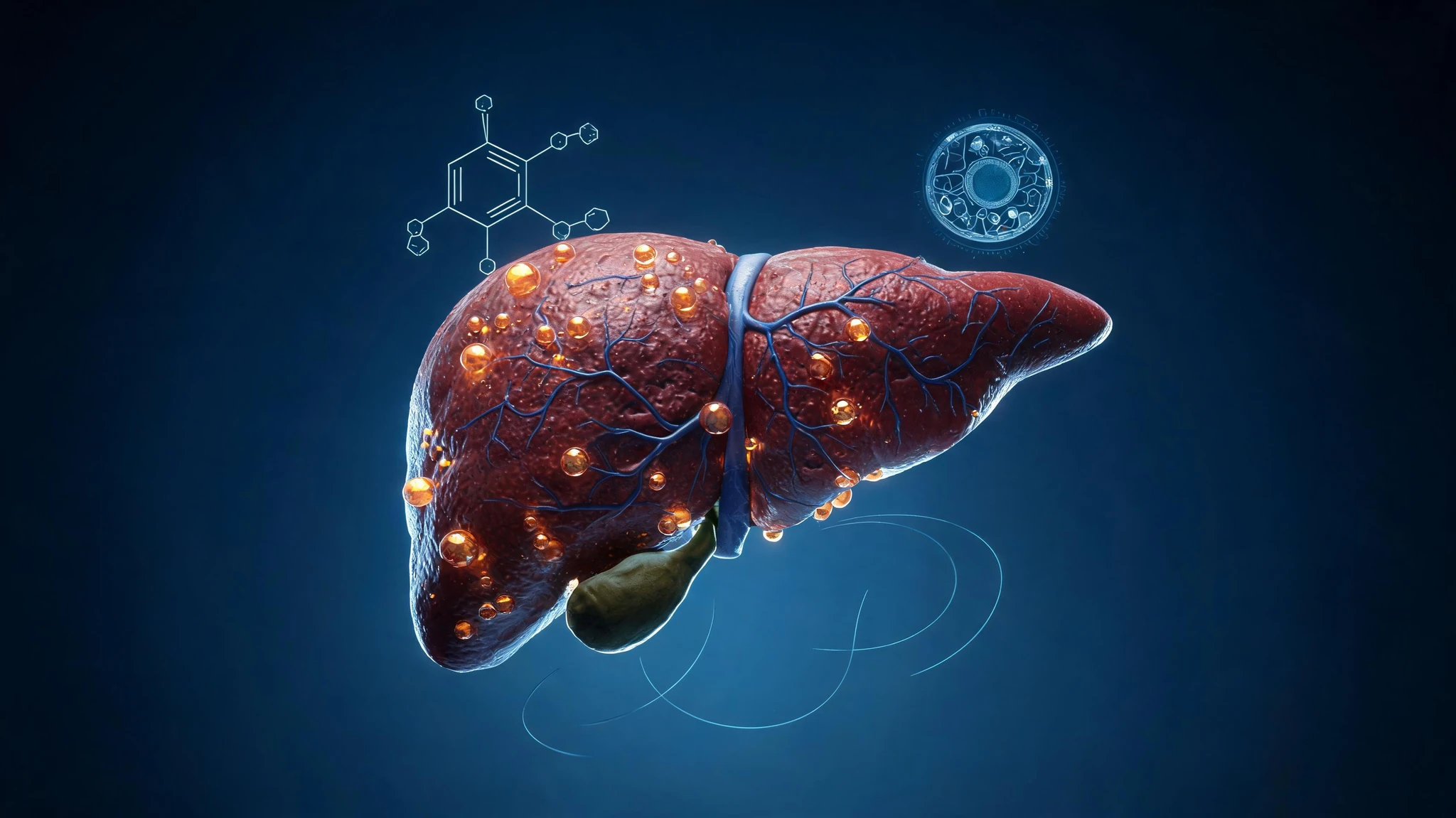
In a tightly controlled 9-day feeding study at Touro University and the University of California, San Francisco, obese children who swapped most of their added sugar for plain starch saw their liver fat drop sharply, even though their daily calorie count stayed the same and their weight barely moved. The original 2016 trial by Lustig and colleagues, published in Obesity, reported that intrahepatic fat fell by roughly a fifth on average, and a follow-up paper in Gastroenterology in 2017 found even larger drops in some children once the team measured liver fat with magnetic resonance spectroscopy.1,2
The headline is unusual because it isolates one variable. Same calories. Same protein. Same fat. The kids lost less than 1 percent of their body weight over the nine days. What changed was the source of their carbohydrates, and that alone was enough to send a measurable signal back through liver fat, fasting insulin, and triglycerides.1
What actually happened in the 9-day study?
The team enrolled 43 Latino and African-American children, ages 9 to 18, all with obesity and at least one feature of metabolic syndrome. Their habitual diets ran heavy on added sugar, around 28 percent of daily calories, with about 12 percent coming from fructose specifically.1 For nine days the researchers replaced most of that added sugar with starchy foods like bagels, pasta, and baked potato chips. Total sugar dropped to 10 percent of calories, fructose to 4 percent. Calories were matched to each child’s normal intake, and the kids were weighed every morning so the team could top up portions if anyone started to lose weight.
That last detail matters. Most diet trials confound two things at once: what you eat and how much. By forcing weight to stay roughly stable, the researchers stripped the experiment down to a single question. Does fructose, on its own, do something to the liver that an equal-calorie portion of starch does not?
The answer, on every metabolic marker they tracked, was yes. Diastolic blood pressure dropped. Triglycerides fell by about 46 percent. LDL cholesterol came down. Fasting glucose and insulin both improved. And liver fat, measured with magnetic resonance spectroscopy, fell from a mean of 7.2 percent to 3.8 percent of organ volume, a relative reduction in the range of 22 to 47 percent depending on the subgroup.1,2
Why does fructose treat your liver differently than glucose?
Glucose, the sugar your body runs on by default, is metabolized everywhere. Most cells in the body have the machinery to pull glucose out of the bloodstream and burn it. The liver only sees a fraction of any given glucose load.
Fructose is different. Almost all of it is processed in the liver, and it bypasses a key regulatory step that normally puts a brake on fat synthesis. Where glucose has to wait for an enzyme called phosphofructokinase to give it permission to enter the energy-making pathway, fructose slips around that checkpoint entirely. When the liver is flooded with fructose, especially from sugary drinks that arrive fast and in large doses, it converts the surplus into fat through a process called de novo lipogenesis.3,5
That fat does not always stay in the liver. Some of it gets exported as triglycerides, which is why fasting triglycerides drop so dramatically when fructose is pulled out. But a meaningful fraction stays put, lodged inside hepatocytes as droplets, the same droplets a doctor picks up on imaging when they say a patient has a fatty liver.5

How is this different from cutting calories?
Plenty of weight-loss studies show liver fat falls when people eat less, exercise more, or both. What makes the Lustig and Schwarz trials interesting is that the children were not asked to lose weight. They were not asked to exercise more. They were given the same number of calories they normally ate, just rearranged.
The follow-up Gastroenterology paper went a step further by measuring de novo lipogenesis directly, using a stable-isotope tracer. After nine days of fructose restriction the rate of new fat being built inside the liver had fallen by roughly half.2 That gave the researchers a mechanistic answer to the question their first paper raised. The improvement was not a vague metabolic ripple effect. It was a specific, measurable reduction in the liver’s fat-making activity.
Stanhope, in a 2016 review of the wider sugar literature, called this kind of evidence the strongest case yet that the metabolic harm of added sugar is not just about its calories.4 Calories matter. They have always mattered. But the type of carbohydrate also seems to matter, particularly when the carbohydrate is liquid fructose arriving in a 20-ounce bottle.
It is not just one study
The 9-day result would be a curiosity if no other line of evidence pointed the same way. It does not stand alone. Ouyang and colleagues in 2008 reported that adults with non-alcoholic fatty liver disease consumed two to three times as much fructose as healthy controls, after controlling for total calories.3 A 2018 review in the Journal of Hepatology by Jensen and colleagues catalogued more than a dozen mechanistic and observational studies converging on fructose as a primary driver of fatty liver, separate from total energy intake.5
None of this proves that fructose alone causes liver disease in any given person. Diet is messy, lives are messy, and the strongest predictor of fatty liver in most populations is still total adiposity. What the trials and reviews together suggest is that fructose punches above its weight. Cutting it produces metabolic improvements that calorie counting alone does not always deliver.

Where does most of the added fructose actually come from?
For a public-health argument to be useful, it has to point to specific foods. In the United States, roughly half of all added sugar in the average diet comes from beverages: soda, sweetened iced tea, sports drinks, fruit-flavored drinks, and the sugary coffee drinks that arrive with a dome lid and a flavor pump. Most of these are sweetened with high-fructose corn syrup or sucrose, both of which are roughly half fructose by weight.4
The rest is scattered across breakfast cereals, flavored yogurts, granola bars, salad dressings, ketchup, jarred pasta sauce, bread, and the long shelf of processed snacks where sugar is doing structural work, not just adding flavor. Whole fruit also contains fructose, but in a form that comes packaged with fiber, water, and a slow rate of absorption. The 9-day study did not restrict whole fruit. It restricted added fructose.
That distinction is the practical takeaway from the trial. You do not need a sugar-free diet to start moving the needle on liver fat. You need a diet that does not pour sugar into a glass.
The numbers behind the beverage problem are blunt. A single 20-ounce bottle of cola contains around 65 grams of added sugar, more than half of it fructose. The American Heart Association suggests an upper limit of 25 grams of added sugar per day for women and 36 for men. One soda blows past either ceiling before lunch. For a child of 11 or 12, the same bottle is two to three times the recommended ceiling, and many kids are drinking more than one a day.
Snack labels use a long list of names that all resolve to fructose in the bloodstream. High-fructose corn syrup is the obvious one, but cane sugar, evaporated cane juice, brown rice syrup, agave, honey, fruit juice concentrate, and the polite “natural sweeteners” line on a granola bar all deliver fructose to the liver. The label-reading exercise is less about chasing each ingredient than about noticing how often one of them appears in the first five lines of the list.
What about adults?
The Lustig trial enrolled children and teenagers, not adults. Their livers are more responsive to dietary change, their habits are easier to control inside a structured study, and their baseline sugar intake was unusually high. None of that translates cleanly into a promise for adults.
That said, the mechanistic story holds across age groups. De novo lipogenesis is not a child-specific pathway. Adult studies of fructose feeding, including the 2009 trial by Stanhope and colleagues at UC Davis, show that high doses of fructose increase visceral fat and worsen insulin sensitivity in just ten weeks, while equivalent doses of glucose do not.4 The reverse experiment, taking fructose out of an adult diet for nine days at matched calories, has not been run with the same precision as the children’s trial. Adults responding the same way is plausible but not proven.

How long does the benefit last?
This is one of the questions the original trial cannot answer. Nine days is the entire duration of the intervention. Whether liver fat stays down at four weeks, twelve weeks, a year, depends entirely on what happens to the diet after the trial ends. If the soda goes back, the fat goes back. The study showed that the liver can respond fast. It did not show that the response is permanent.
Longer trials of dietary sugar restriction are starting to fill in the gap. The pattern across them is consistent. Liver fat tracks added sugar intake, and the response is reversible in both directions. People who reduce added fructose see the marker fall. People who go back to baseline see it climb. The good news is that the liver is unusually forgiving early in the disease, with measurable improvements possible in days rather than months.5
What this study does not say
It does not say sugar is poison. It does not say all carbs are bad. It does not say fruit is dangerous. It does not say a small dessert will damage your liver. It does say that the heavy, daily, liquid sugar load that has become normal in the modern food environment is the part of the diet that liver tissue seems to react to most directly. The most useful version of that message is also the simplest. Drink water. Save the soda for an occasion.
Common questions about fructose and liver health
Does eating fruit cause fatty liver?
Whole fruit was not restricted in the 9-day study, and observational data do not link fruit intake to fatty liver. Fiber, water content, and slow absorption seem to blunt the metabolic effect of the fructose in fruit.
Is high-fructose corn syrup worse than table sugar?
Probably not in any meaningful way. Both are roughly half fructose. The bigger driver is total added fructose intake, not which specific sweetener delivers it.
How fast can liver fat drop?
In the trial described above, measurable reductions appeared within nine days at matched calories. That does not mean every person will respond at that pace, but the liver can clearly move quickly when fructose intake falls.
Do I need to count grams of fructose?
Probably not. Most of the impact comes from removing sugary drinks and obviously sweetened processed foods. The label-reading version of the diet works fine without a calculator.
Is this safe for kids?
Reducing added sugar is broadly safe and aligns with current pediatric nutrition guidance. Major dietary changes for a child with diagnosed liver disease should be coordinated with a pediatrician or registered dietitian.
The honest version of the takeaway
A 9-day study is small. The participants were specific. The food was prepared and delivered, which is not how most people eat. Replicating the exact protocol at home is not the goal, and probably not necessary. The useful finding is that the liver responds to fructose, specifically and quickly, and that response is independent of weight. If your daily diet is heavy on sweetened drinks and packaged snacks, the early metabolic markers in your blood and liver are probably tracking that intake more closely than a calorie counter would suggest.
None of this is medical advice. If you have been told you have elevated liver enzymes, fatty liver, insulin resistance, or pre-diabetes, the conversation about what to change belongs with your clinician, who can look at your full picture instead of a single trial. The 9-day result is a hopeful data point, not a prescription. The hopeful part is that change can show up faster than most people expect.
Sources
- Lustig RH, Mulligan K, Noworolski SM, Tai VW, Wen MJ, Erkin-Cakmak A, Gugliucci A, Schwarz JM. Isocaloric fructose restriction and metabolic improvement in children with obesity and metabolic syndrome. Obesity (Silver Spring). 2016;24(2):453–460. PubMed: 26499447
- Schwarz JM, Noworolski SM, Erkin-Cakmak A, Korn NJ, Wen MJ, Tai VW, Jones GM, Palii SP, Velasco-Alin M, Pan K, Patterson BW, Gugliucci A, Lustig RH, Mulligan K. Effects of Dietary Fructose Restriction on Liver Fat, De Novo Lipogenesis, and Insulin Kinetics in Children With Obesity. Gastroenterology. 2017;153(3):743–752. PubMed: 28579536
- Ouyang X, Cirillo P, Sautin Y, McCall S, Bruchette JL, Diehl AM, Johnson RJ, Abdelmalek MF. Fructose consumption as a risk factor for non-alcoholic fatty liver disease. Journal of Hepatology. 2008;48(6):993–999. PubMed: 18395287
- Stanhope KL. Sugar consumption, metabolic disease and obesity: The state of the controversy. Critical Reviews in Clinical Laboratory Sciences. 2016;53(1):52–67. PubMed: 26376619
- Jensen T, Abdelmalek MF, Sullivan S, Nadeau KJ, Green M, Roncal C, Nakagawa T, Kuwabara M, Sato Y, Kang DH, Tolan DR, Sanchez-Lozada LG, Rosen HR, Lanaspa MA, Diehl AM, Johnson RJ. Fructose and sugar: A major mediator of non-alcoholic fatty liver disease. Journal of Hepatology. 2018;68(5):1063–1075. PubMed: 29408694