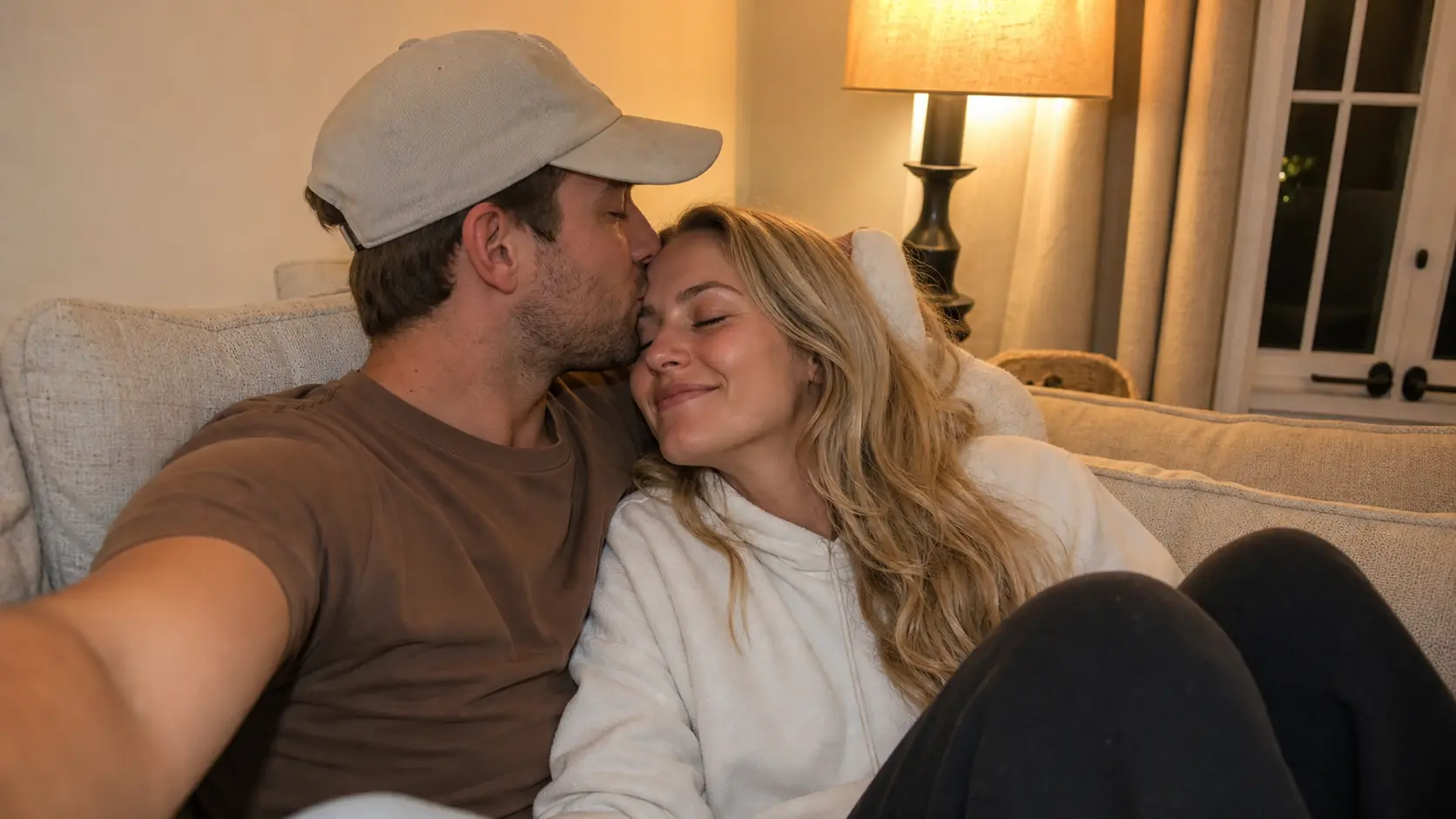
Couples therapist John Gottman has spent more than four decades watching couples in his Seattle “Love Lab,” and one of his most-quoted prescriptions is almost embarrassingly small: kiss your partner for six seconds, every day, on purpose. The pitch sounds like wellness fluff. The biology underneath it is not.
Peer-reviewed studies on warm partner contact in the years since have shown that even brief, deliberate physical closeness with a romantic partner shifts measurable stress hormones, raises circulating oxytocin, and softens the cardiovascular response to everyday stressors1,2. A six-second kiss is not a cure. It does, however, look a lot like the smallest dose of intimacy a body can register.
Where the six-second number actually comes from
The “six-second kiss” is a clinical recommendation, not a randomized trial. Gottman built it inside his couples-therapy work after observing that brief, perfunctory pecks at the door, the kind that take less than two seconds and double as a logistical handoff, were behaving more like errand items than connection. He started prescribing a longer kiss, held on purpose, as a tiny ritual that pulled couples out of operations mode and back into being a couple. Six seconds is short enough that nobody can pretend they don’t have time. It is also long enough that, for most people, you cannot keep your mind on the grocery list.
That timing is not magic. Nothing biologically special happens at second 5.9 versus second 4.7. What the duration does is force a small, conscious shift of attention toward your partner, with skin contact, eye softening, and slowed breath. The biology that follows, though, is real and well-documented in adjacent research on warm partner contact and affectionate touch.
What happens in your body in those six seconds
Romantic touch lights up an old, slow, mammalian circuit. The hypothalamus, sitting deep under the cortex, releases oxytocin into the bloodstream and across nearby brain regions. Oxytocin is best known from childbirth and breastfeeding, but it is also the chemistry of pair bonding in adults. In a study of 38 cohabiting couples, partners who had just shared a brief warm contact with their partner showed significantly higher plasma oxytocin and lower cortisol, the body’s main stress hormone, compared with a no-contact control condition1. Norepinephrine, another stress signal, dropped with it. Blood pressure responses to a subsequent stressor were softer in the contact group.
Dopamine and endorphins join the party in smaller, less easily measured ways. Dopamine handles the bright, motivational “I want to be near this person” pull. Endorphins are the body’s own opioid analgesics, which is part of why a long hug from someone you love can blunt physical aches as well as emotional ones. None of this is mystical. It is a body recognizing safety.

Why a kiss, specifically, and not just a hug
Researchers studying touch tend to lump kissing and hugging together as “warm partner contact” because both deliver skin closeness, slowed breath, and parasympathetic cues. A 2005 study of premenopausal women found that those who hugged their partners more frequently had higher resting oxytocin and lower resting blood pressure and heart rate2. The same lab’s earlier work showed cortisol fell during a brief warm-contact protocol that mixed hugging and gentle physical closeness1.
Kissing adds something hugging does not. It involves the lips and tongue, two of the most densely innervated patches of skin on the human body, and it requires you to be face-to-face with eyes closed. It is also harder to do absent-mindedly. A hug can happen with a phone in one hand. A kiss, held for six seconds, can’t.
There is at least one peer-reviewed paper that puts kissing itself, rather than touch in general, under a microscope. In a 2023 analysis of a national probability sample published in Health Communication, kissing frequency in romantic relationships was associated with healthier blood lipid patterns, and that link was statistically mediated by stress4. In plain terms: people who kiss their partner more report less stress, and that lower stress shows up downstream in cardiovascular markers.
The cortisol story is where this gets interesting
Cortisol is not a villain. It is the hormone that gets you out of bed and through a tough meeting. The problem is chronic background elevation, the kind that runs underneath weeks of poor sleep, financial worry, or a relationship that feels lonely from the inside. Long-term cortisol load chews on the cardiovascular system, the immune system, and the parts of the brain involved in memory and mood.
Affectionate physical contact is one of the few interventions that reliably nudges cortisol down in healthy adults. In a study by communication researcher Kory Floyd and colleagues at Arizona State, couples who increased their affectionate touch over six weeks showed faster recovery of stress hormones after a lab stressor than couples in a control group3. The effect was not enormous. It was, however, consistent and statistically robust, and it stacked across the trial period.
What is striking about the six-second kiss as a behavioral target is how small the dose is. Six seconds, twice a day at the door, plus a longer one in the evening, totals less than a minute. Compared with a meditation app or a gym habit, the friction is almost zero. The trade-off is that you have to actually do it, with the same person, on a day when you are mildly annoyed at them.

What kissing does to the brain, not just the bloodstream
Brain-imaging work on oxytocin in humans is younger and noisier than the hormonal work, but a clear thread is emerging. Oxytocin appears to dampen activity in the amygdala, the brain’s threat-and-vigilance hub, while strengthening the resting-state connection between the amygdala and parts of the medial frontal cortex involved in social interpretation and emotional regulation5. Translated out of the jargon: under oxytocin, the brain is less twitchy about social threat and better at putting other people’s behavior in a generous frame.
You can see why a couples therapist would care. A lot of marital damage happens in the seconds after a small misread: a tone of voice that lands harder than intended, a sigh interpreted as contempt. A brain marinating in slightly more oxytocin and slightly less cortisol is a brain that is more likely to give a partner the benefit of the doubt for one more breath, which is sometimes the difference between a quiet evening and a fight.
This is not a claim that kissing rewires personality. It is a claim that the daily emotional baseline you bring into a conversation is partly hormonal, and you have small, cheap levers on it.
Six seconds against the everyday entropy of long-term relationships
Long-term partnerships are quietly hostile environments for sustained intimacy. Two careers, often two phones, frequently kids, sometimes commutes, almost always sleep debt. Affection has to compete with logistics, and logistics usually win. Gottman’s broader research over decades, including work tracking more than 650 couples in his Seattle lab, suggests that the couples who stay together and stay happy are not the ones who never fight. They are the ones who maintain a steady ratio of small positive bids over small negative ones, and who repair quickly after rupture.
The six-second kiss is engineered for that landscape. It is short enough to survive a busy morning, ritualized enough that it doesn’t depend on mood, and physical enough that it bypasses the part of the brain that is busy drafting a reply email. Couples who use it as a doorway ritual, once leaving and once returning, build two natural micro-reunions into the day. Over a year that is roughly seven hundred small acts of “I am still choosing you,” delivered without speeches.

What the evidence does not say
Honest reading of the literature requires turning the lights up on the limits. The kissing-and-lipids paper is correlational, drawn from a national survey, and stress-mediation models cannot prove that kissing more makes you healthier in the way a randomized trial could4. The oxytocin and partner-contact studies are small, mostly run on healthy, mostly heterosexual, mostly white North American couples1,2. The Floyd affection trial showed faster cortisol recovery, not a cure for chronic stress3. Brain-imaging work on oxytocin has had its own replication wobbles, and the amygdala-connectivity finding is one piece of a larger, still-debated picture5.
None of that is a reason to dismiss the practice. It is a reason to size it correctly. A daily six-second kiss is a small, low-cost behavioral lever with a plausible biological backbone and modest, supportive evidence. It is not a substitute for therapy if a couple is in a real crisis, not a treatment for clinical depression or anxiety, and not a fix for a relationship that has gone cold for structural reasons.
How to actually make the six-second kiss a habit
The single most common reason couples bounce off this advice is that they tie it to mood. They wait to feel like it. Mood, in long relationships, is an unreliable trigger. The intervention works best as a ritual stapled to an existing cue: the doorway in the morning, the doorway in the evening, the moment one of you closes the laptop for the night. Six seconds, eyes closed, no phone in either hand. Count if you have to. Most people stop counting after about four nights because it stops feeling like a chore.
It also helps to drop the romantic-comedy framing. A six-second kiss is not supposed to be cinematic. On a Tuesday in February, when one of you has a head cold and the other is annoyed about the dishwasher, it can be perfunctory and still do its job. The biology does not check whether you meant it. It checks whether you did it.
Couples who are physically out of practice can ease in with longer hugs first. The same partner-contact research that supports the kiss supports a long, breath-slowing hug as a near-equivalent dose, especially for couples for whom kissing has become loaded1,2.
Common questions about the 6-second kiss
Is six seconds a scientifically proven threshold?
No. It is a clinical rule of thumb popularized by Gottman, useful because it is concrete. The underlying biology of oxytocin release and stress reduction during warm partner contact is what is supported by peer-reviewed studies, not the precise duration1,2.
Does it work if my partner and I are not very physically affectionate?
Probably yes, and it tends to work better the more out of practice you are, since you are starting from a lower baseline. Start with hugs of 20 to 30 seconds for a week if a six-second kiss feels like too much, then add the kiss.
Can it help if we are fighting a lot?
It can take some heat out of small daily friction, but it will not fix a serious rupture or untreated contempt. Couples in active distress benefit far more from structured therapy than from any single ritual.
Are there health risks?
For healthy adults in a monogamous relationship, no meaningful ones. Couples managing active cold sores, mono, or other transmissible infections should pause kissing during flares.
Does the time of day matter?
Mornings and reunions are the highest-leverage slots, because they bracket the parts of the day most likely to drift into pure logistics.

The honest version of the claim
A six-second kiss a day is not a wellness trick. It is a small, repeatable act of attention between two people who already share a life, and the body, helpfully, is wired to reward that attention with a brief, real shift in stress chemistry. The studies do not promise that a couple who kisses for six seconds will stay together forever, or that they will be measurably healthier in twenty years. They do suggest, with reasonable consistency, that warm partner contact lowers cortisol, raises oxytocin, softens cardiovascular reactivity, and is associated with healthier downstream markers in the people who do it more.
The cost is six seconds. The hardest part is remembering, on the days when remembering feels like the thing you can least afford. Those are usually the days it does the most.
Sources
- Grewen KM, Girdler SS, Amico J, Light KC. Effects of partner support on resting oxytocin, cortisol, norepinephrine, and blood pressure before and after warm partner contact. Psychosomatic Medicine. 2005. PubMed: 16046364
- Light KC, Grewen KM, Amico JA. More frequent partner hugs and higher oxytocin levels are linked to lower blood pressure and heart rate in premenopausal women. Biological Psychology. 2005. PubMed: 15740822
- Floyd K, Mikkelson AC, Tafoya MA, et al. Human affection exchange: XIII. Affectionate communication accelerates neuroendocrine stress recovery. Health Communication. 2007. PubMed: 17668992
- Floyd K. Lipidemic Effects of Kissing are Mediated by Stress: Results from a National Probability Sample. Health Communication. 2023. PubMed: 35287520
- Sripada CS, Phan KL, Labuschagne I, Welsh R, Nathan PJ, Wood AG. Oxytocin enhances resting-state connectivity between amygdala and medial frontal cortex. International Journal of Neuropsychopharmacology. 2013. PubMed: 22647521