Losing just 1 to 2 percent of your body weight in water is enough to measurably slow your attention, your short-term memory, and your mood, according to a 2018 meta-analysis of 33 studies published in Medicine and Science in Sports and Exercise1. That is roughly the fluid loss of a single missed water bottle on a warm afternoon, or a hard hour at the gym without sipping anything.
The effect is small but real. Researchers Matthew Wittbrodt and Melinda Millard-Stafford pooled data from hundreds of healthy adults and found that once dehydration crossed the 2 percent threshold, performance on tasks like sustained attention, executive function, and motor coordination dropped in a way that statistics could not explain away1. Below 1 percent, the effect almost disappeared. The window in between is where most office workers, runners, and parents quietly spend their afternoons.
What does 1 to 2 percent body mass actually mean?
For a 160-pound adult, 2 percent body mass is about 3.2 pounds, or roughly 1.5 liters of water. That sounds like a lot until you remember the routes by which water leaves the body. Breathing alone costs around 250 to 350 milliliters a day. Skin loses another 450 milliliters in cool conditions, more in heat. A brisk one-hour walk in summer can pull off another half liter through sweat. Add a coffee, skip the glass with lunch, and the math gets uncomfortable fast.
Older adults reach the 2 percent line faster than younger ones, partly because the thirst signal weakens with age and partly because total body water trends down across the decades. Athletes in heat get there in under an hour. Office workers sitting in dry, air-conditioned buildings often get there without noticing, because the cues are subtle and the coffee on the desk feels like enough.
Body composition matters too. Muscle holds more water than fat, so a lean person of any given weight starts with a slightly larger reservoir. That is one reason hydration researchers prefer to express the threshold as a percentage of body mass rather than a fixed number of glasses. The percentage scales with the person.
Why does mild dehydration affect the brain at all?
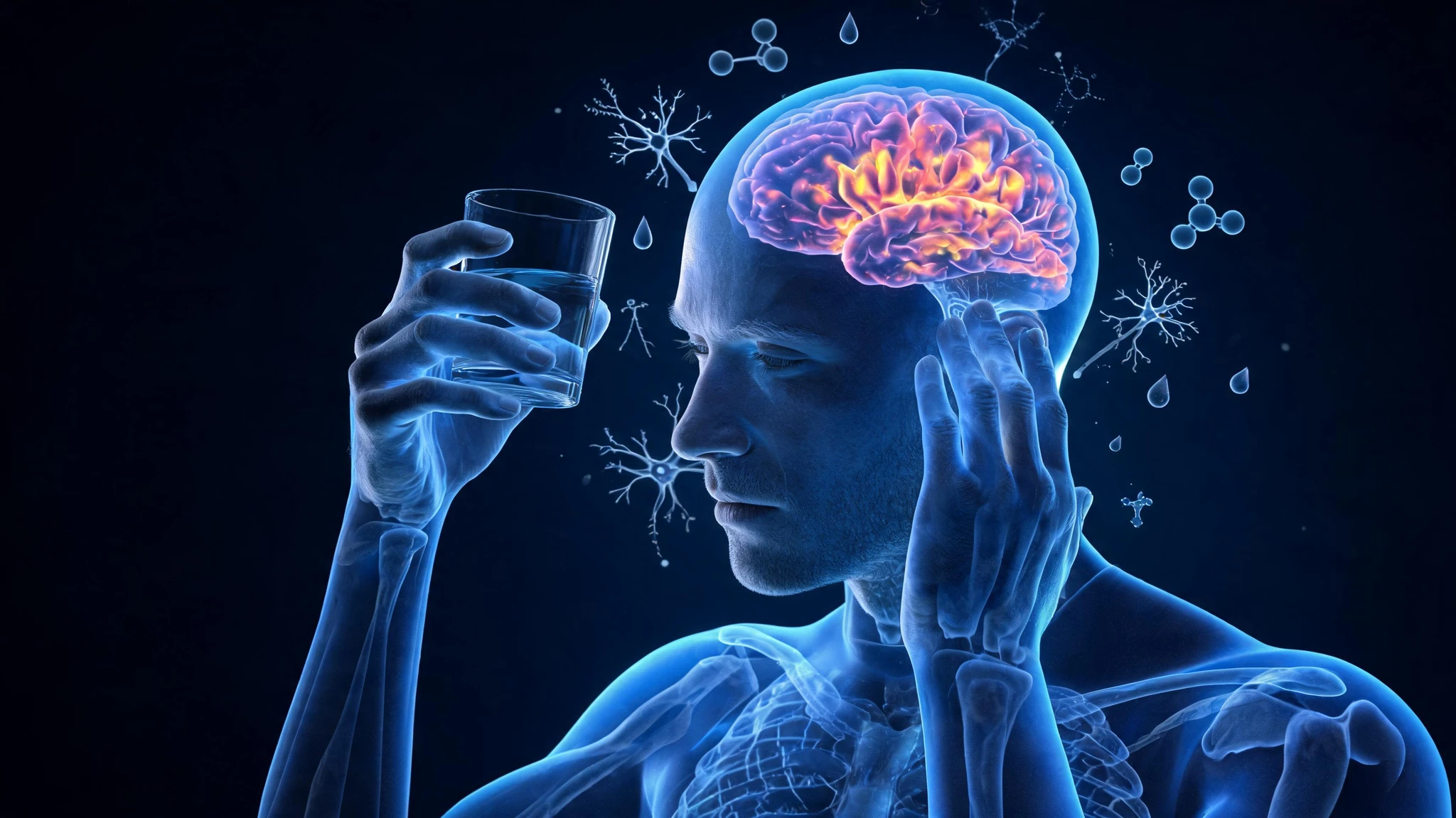
The brain is about 75 percent water. It also runs hot, metabolically speaking, and depends on a steady supply of oxygen and glucose delivered by blood. When body water drops, plasma volume drops with it. The heart works harder to keep cardiac output stable, and cerebral blood flow can shift in measurable ways. Functional MRI studies have shown that dehydrated subjects performing the same cognitive task tend to recruit more neural activity in the prefrontal and parietal regions to keep performance steady, almost as if the brain is paying a tax to hold the line4.
That extra effort is what people feel as fog. Tasks that used to be easy still get done, but they cost more. By late afternoon the budget is spent, and concentration starts to slip. The 2018 meta-analysis is careful to note that the size of the effect varies by task. Tests that demand sustained attention, working memory, and motor speed are most sensitive. Tests of simple reaction time hold up better1.

The Ganio and Armstrong studies: where the numbers come from
Two of the cleanest experiments on this topic came out of the University of Connecticut and France’s Hydration and Health Department around the same period. In 2011, Matthew Ganio and colleagues put 26 healthy young men through three trials each: a normally hydrated control, a mild dehydration condition with exercise, and a mild dehydration condition with exercise plus a diuretic2. The dehydration target was 1.59 percent of body mass, well inside the so-called mild zone. Working memory and vigilance held up reasonably well, but the men reported significantly more fatigue, more tension and anxiety, and rated tasks as subjectively harder when they were dehydrated.
The following year, Lawrence Armstrong’s team ran the parallel study in 25 healthy young women3. The dehydration target was the same. The women showed a similar pattern of mood disturbance, with increased fatigue and lower vigor, and they reported headaches more often than the men. Performance on a battery of cognitive tasks was mildly impaired. Drinking water restored the mood scores almost completely. Both studies used induced dehydration in a lab, which is not exactly how it happens in real life, but the controlled design lets researchers say with confidence that the water itself, not the exercise or the heat, is doing most of the work.
Adan’s 2012 review in the Journal of the American College of Nutrition pulled these threads together and added a useful caveat: children and older adults tend to show stronger effects at the same level of fluid loss, probably because their thermoregulation and thirst response are less robust4. For young, fit adults, the effect is real but modest. For the rest of us, it can be a meaningful chunk of the day.
How long does the effect last after you drink?
Restoration is fairly quick. In the Armstrong trial, mood scores came back to baseline within an hour of rehydrating3. Cognitive tasks recover on a similar timeline, though the data are noisier. The reason is mechanical: water absorbed from the small intestine reaches the bloodstream within minutes, plasma volume rebuilds, and the cardiovascular shortcut your brain was taking gets undone.
That timeline is part of why the practical advice is so simple. You do not need to chase a hydration target all day. You need to notice when you are slipping and drink a glass. Most adults who feel mid-afternoon fog will perk up within 30 to 60 minutes of a tall glass of plain water, assuming dehydration was actually the problem. If it is not, the water will not hurt, and the absence of improvement is itself useful information.
One small caveat from the experimental work: rehydration speed depends on what you drink. Plain water is fast. A drink with sodium and a little sugar is faster, because sodium pulls water across the gut wall and small amounts of glucose accelerate the cotransporter that does the pulling. That is why oral rehydration solutions exist, and why a sports drink can outperform plain water during heavy exertion. For ordinary office fog, the difference is negligible, and a glass of tap water will do the job.

How much water is enough?
The honest answer is that it depends. The U.S. National Academies suggest roughly 3.7 liters of total water a day for adult men and 2.7 liters for adult women, which includes water from food. Most fruits and vegetables are 80 to 95 percent water by weight, and a typical mixed diet supplies around 20 percent of total intake. That leaves 2 to 3 liters from drinks for most people, including coffee and tea.
Coffee counts. The old idea that caffeinated drinks dehydrate you has been walked back by hydration researchers; at moderate doses, the diuretic effect is small enough that the net contribution of a cup of coffee to daily water intake is positive. The same is true for tea. Alcohol is the exception. Beer, wine, and spirits all suppress the antidiuretic hormone vasopressin and pull water out faster than they put it in.
A useful rough check is urine color. Pale straw is the target. Bright yellow or dark amber suggests you are behind. If your urine is consistently colorless, you are probably drinking more than you need, which is harmless for most healthy people but worth knowing.
Who is most at risk for the brain fog effect?
Three groups stand out in the literature. Older adults lose thirst sensitivity, often dramatically by their seventies. They can be 2 to 3 percent dehydrated and not feel thirsty at all, which is one reason cognitive complaints in nursing homes sometimes resolve overnight when staff add a structured fluid round.
People who exercise in heat are an obvious second group. A summer cyclist can lose 1 to 2 liters an hour. Sweat replaces water with salt, so prolonged effort needs both fluid and electrolytes. The 2018 meta-analysis specifically called out exercise heat stress as the most common route into the impairment zone1.
The third group is harder to spot: knowledge workers in dry indoor air. Heating, air conditioning, and long video calls all conspire to push people toward chronic mild dehydration without ever crossing into anything that feels alarming. The brain pays the bill in the form of foggier afternoons, shorter tempers, and more mistakes.

It is not the only thing that causes brain fog
Hydration is one variable. It sits next to sleep, blood sugar, stress, screen time, hormones, and any number of medical issues that can produce the same subjective fog. The honest version of the advice is that drinking water is a cheap, low-risk first thing to try. If a glass at 3 p.m. and another at 5 p.m. fixes the problem, the problem was probably mild dehydration. If it does not, look elsewhere.
Persistent fog that does not respond to fluids, sleep, and food deserves a clinician’s attention. Thyroid problems, anemia, depression, sleep apnea, post-viral syndromes, and certain medications all produce cognitive symptoms that look a lot like dehydration from the inside. None of them are fixed by a water bottle.
Practical habits that actually move the needle
The research supports a few small habits more than any single hydration rule. Keep a glass or bottle within arm’s reach during the workday. Drink something with every meal, every coffee, and every transition between tasks. Pre-hydrate before exercise rather than chasing the deficit afterward. In hot weather or on long flights, add a pinch of salt to one of your bottles, or use an oral rehydration sachet, so you are not just diluting the sodium you have left.
None of this is news. The interesting part of the science is not the prescription, which is roughly what your grandmother told you. It is how small the deficit has to be before performance starts to drift. Two percent is not a heatstroke number. It is the amount of water you can lose in a normal afternoon by accident.
Common questions about dehydration and brain function
Does coffee count toward daily water intake?
Yes, at moderate doses. The mild diuretic effect of caffeine is more than offset by the volume of fluid in the cup, so a typical coffee or tea is a net contributor to hydration.
Can you drink too much water?
It is rare in healthy adults but possible, especially during long endurance events. Excessive plain water without sodium can lower blood sodium to dangerous levels, a condition called hyponatremia. The risk is mostly relevant for marathoners and ultra-endurance athletes.
Will being dehydrated really change a memory test?
The 2018 meta-analysis found measurable, statistically significant declines in attention, executive function, and motor tasks once fluid loss crossed about 2 percent of body mass1. Effect sizes were small but consistent.
Does thirst reliably tell you when to drink?
For young, healthy adults at rest, mostly yes. In hot weather, during exercise, in older adults, and in some chronic conditions, thirst lags behind real fluid need by quite a bit. Scheduled sips beat waiting for thirst in those cases.
Is bottled water better than tap?
For hydration purposes, no. Whatever your local tap water is, in most developed countries, it is functionally identical to bottled. The glass matters more than the source.
The honest takeaway
Mild dehydration is one of the easiest variables to fix in a normal day. The studies do not promise that drinking water will make you smarter. They suggest, fairly consistently, that being meaningfully under-hydrated drags performance and mood down in ways most people would feel if they paid attention. A glass of water is not a cure for a difficult afternoon, but it is a cheap thing to try first, and the evidence behind it is more solid than most wellness advice that gets passed around online.
The point is not to count milliliters. It is to notice when the bottle on the desk has been full for three hours, and to do something about it before the brain has to work harder than it needs to.
Sources
- Wittbrodt MT, Millard-Stafford M. Dehydration Impairs Cognitive Performance: A Meta-analysis. Medicine and Science in Sports and Exercise. 2018. PubMed: 29933347
- Ganio MS, Armstrong LE, Casa DJ, et al. Mild dehydration impairs cognitive performance and mood of men. British Journal of Nutrition. 2011. PubMed: 21736786
- Armstrong LE, Ganio MS, Casa DJ, et al. Mild dehydration affects mood in healthy young women. Journal of Nutrition. 2012. PubMed: 22190027
- Adan A. Cognitive performance and dehydration. Journal of the American College of Nutrition. 2012. PubMed: 22855911